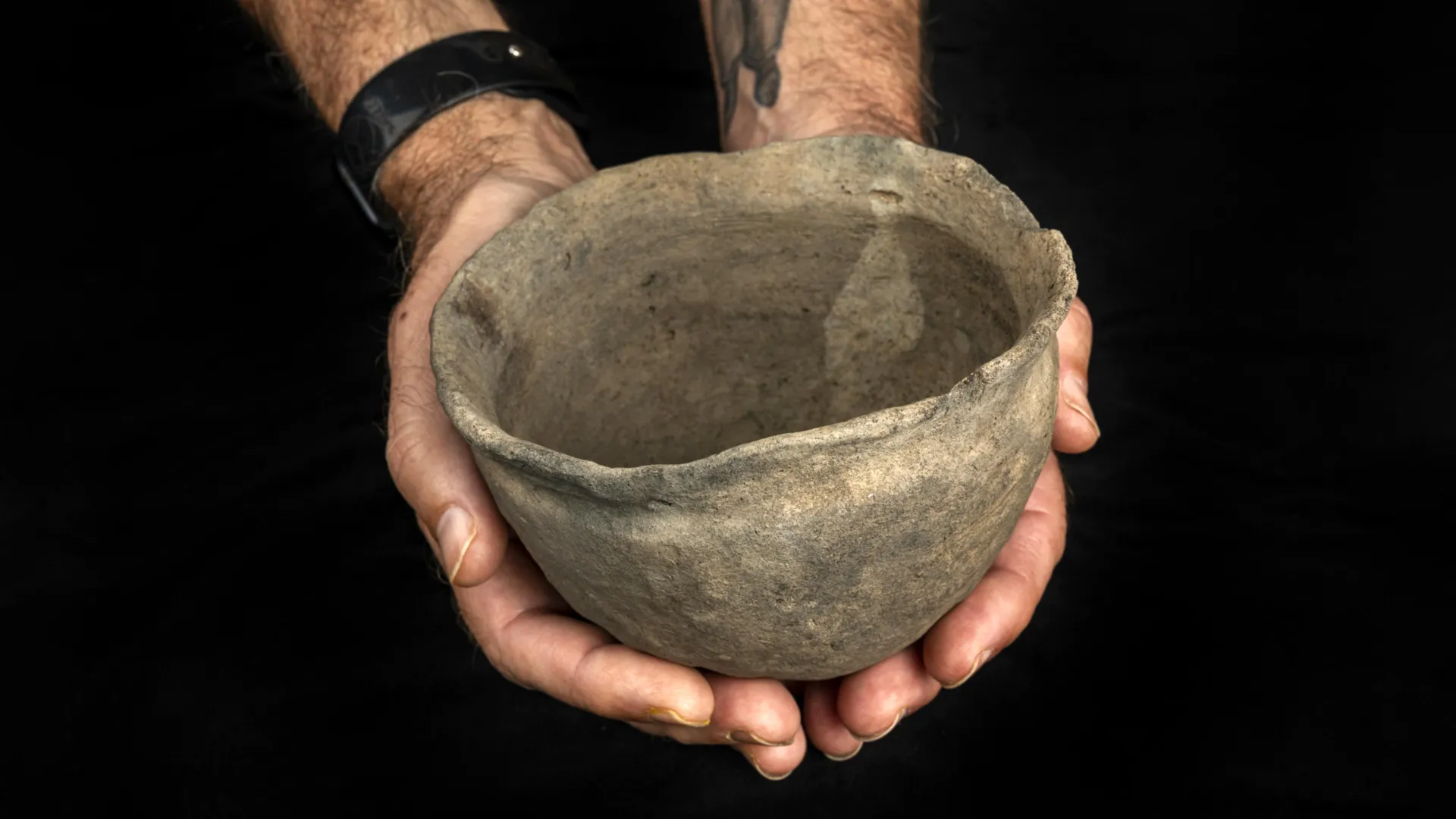
Roughly 400 years ago, a member of the Indigenous Potano-Timucua tribe shaped a small clay vessel by hand. The pot was compact enough to fit in a palm, with a simple rim, a smooth dull gray surface, and no decoration. Its original purpose is unknown, as is the number of people who may have used it.
What archaeologists do know is that the vessel survived for centuries underground before University of Florida students uncovered it earlier this year, still completely intact. Typically, we find things that were broken and discarded," said Gifford Waters, collections manager for historical archaeology at the Florida Museum of Natural History. "You don't leave things behind that you can still use, so why was this purposefully put into a pit?" Waters has encountered complete artifacts while working with shipwreck collections, where intact objects are more common.
But this was the first time in his career that he had been part of a team that excavated an entirely unbroken pottery vessel from a terrestrial site. Even pottery that enters the ground whole often cracks over the centuries as soil pressure, farming, construction, and other disturbances shift the earth around it. Students Explore a Centuries-Old Florida Mission The discovery was made by students taking a field course taught by Waters and Charles Cobb, curator of historical archaeology at the museum.
Each Friday during the spring semester, students practice the basic techniques of archaeological fieldwork while investigating Mission San Francisco de Potano, a centuries-old site in northwest Gainesville. The former mission is now a wooded area marked by 1-by-1 meter (approximately 3-by-3 foot) excavation squares. Students carefully remove soil with trowels while moving along paths between areas containing the remains of a 17th-century kitchen, a friar's residence, and the surrounding Potano village.
The Potano were part of the Timucua people of North Florida. In 1585, they relocated to the area after Spanish forces forced them from their earlier home, which was probably situated between present-day Payne's Prairie and Orange Lake. In 1606, Spain sent a friar to the Potano village to establish a mission.
It became one of the earliest of more than 100 Catholic missions founded during the following century as Spain worked to maintain control of Florida. Mission San Francisco de Potano was abandoned in 1706, and physical traces of the settlement gradually disappeared from view until artifacts began to turn up in the 1950s. Thousands of Artifacts Reveal Daily Life At its height, the village likely contained several hundred Potano residents, while the mission itself was home to just one European, the friar.
Extract — continue reading at the source.


