Some 1,700 years ago, a married couple was buried in a pyramid-shaped tomb in the Dakhla Oasis, a fertile patch of land in Egypt’s Western Desert. The man, named Pisechtes, or Psychtis, may have been a judge—and if the ancient poem inscribed on his funerary stela is any indication, he was deeply mourned by his loved ones. Angelos Chaniotis, a classicist at the Institute for Advanced Study in New Jersey, tells Live Science’s Owen Jarus that the inscription, written on the stone slab in ancient Greek, describes Pisechtes as an “adviser in life” who was known for his kindness and wisdom.
The elegy’s final lines find Pisechtes’ son Sarapion addressing him directly, proclaiming, “Listen, father!” Sarapion then “asks him to accept the funerary libations and offerings of lamenting children,” Chaniotis says. Archaeologists with Egypt’s Supreme Council of Antiquities recently discovered Pisechtes’ mud-brick tomb while excavating the Bir al-Shaghala necropolis, a burial site for elite residents of the oasis’ ancient capital, Mothis. In addition to the stela, the grave boasts a sandstone offering table and purification basin, an assortment of pottery, and a bronze coin bearing the likeness of the Roman emperor Constantine.
Excavations at the necropolis have been ongoing since 2002. The finds reflect the region’s diverse blend of influences, from the famous pharaohs of the Egyptian New Kingdom to the Hellenistic legacy of ancient Greece to Egypt’s time as a Roman province, which began in 30 B.C.E. with the death of Cleopatra. The tomb’s entrance is located at the bottom of a 14-step staircase.
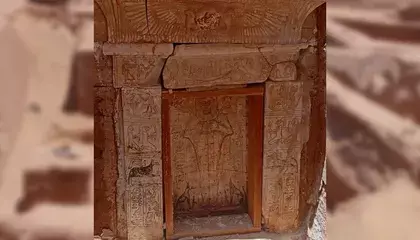
Crafted from sandstone, it’s adorned with hieroglyphic inscriptions intended to protect and guide the dead in the afterlife, as well as decorations such as a winged sun disc, two cobras and a carving shaped like a bundle of reeds. The beam above the door features a scene from the seventh hour of the Amduat, a New Kingdom funerary text that records the Egyptian sun god Ra’s journey through the underworld. According to the Royal Collection Trust, this section finds Ra facing “the most terrifying being of the netherworld: Apophis, the great serpent blocking his passage,” an embodiment of “chaos and evil.” Per the statement, the depiction is the first of its kind uncovered at Bir al-Shaghala.
Inside the tomb, a hall with a partially collapsed vaulted ceiling stands next to a pair of mud-brick burial chambers topped by the pyramid-shaped upper section. As for Pisechtes’ stela, the researchers found the slab embedded in the structure’s southern wall. The 19-line poem inscribed on the object “is a highly literary and original epigram,” says Chaniotis, who wasn’t involved in the recent excavations.
Many of the tombs found at the site feature pyramid-shaped upper sections, in line with the newly discovered burial. According to a 2020 article published in the journal Varia, the necropolis’ tombs tend to include “three constant architectural components: … an open-air court, a ground floor with masonry-vaulted rooms, and a second story with a pyramid and a chapel.” This design has rarely been observed elsewhere in Roman Egypt. Pisechtes’ tomb may have been reused after his death.
Extract — continue reading at the source.