In 2010, archaeologists conducting excavations ahead of construction in Musselburgh, Scotland, stumbled upon the remains of four Roman-era men. Their heads had been separated from their bodies, apparently after death. Experts don’t know exactly why these individuals were decapitated postmortem, but they have a few theories: Perhaps the ritual was a holdover from an early Celtic cult that attributed power to severed heads.
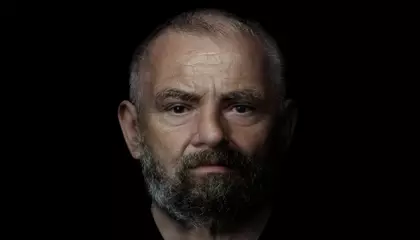
Alternatively, the beheadings might have served as a punishment or a precaution to ensure the dead didn’t come back to life. The rationale for the decapitations might be unclear, but that hasn’t stopped archaeologists from piecing together what happened to these ancient Britons during their lifetimes. Thanks to a cutting-edge collaboration led by National Museums Scotland (NMS), the public can now envision what one of the men looked like when he died in his early 50s, between 140 and 165 C.E.
A digital reconstruction of his face will soon go on view alongside his skull in “Roman Scotland: Life on the Edge of Empire,” a forthcoming exhibition at NMS’ flagship Edinburgh location. The man “lived a hard and physically active life,” according to a statement, “and his appearance would have betrayed his age through lines around his brown eyes and the graying of his dark hair.” Although he lived near the Roman fort of Inveresk, he probably wasn’t a soldier, as he had a condition that would have prevented him from easily wielding a sword in his right hand. Reid, an archaeologist at the Trimontium Trust who wasn’t involved in the research, tells Live Science’s Tom Metcalfe that the individual might have worked a “desk job,” perhaps serving as a clerk or in another noncombat role.
Alternatively, he may have simply used his left hand to hold a weapon. We cannot know how exactly he looked, but we think his family and friends would have spotted the likeness.” To approximate the man’s appearance, forensic artist Chris Rynn drew on an osteoarchaeological assessment conducted by NMS, isotopic analyses led by experts at Durham University, and ancient DNA extracted by the University of York and Harvard Medical School. As Rynn writes in an Instagram post, “Hair, eyes and skin color [are] all determined by DNA, but a range of possible hairstyles are depicted, which all fit the DNA analysis.” These looks include a thinning widow’s peak and a bushy beard flecked with streaks of gray, as well as a fuller head of curly dark hair.
A post shared by Dr Christopher Rynn (@chris_rynn) The individual’s skeleton shows that he suffered several serious injuries, including a broken nose and a rib fracture, both of which had healed by the time of his death. He had a bone growth around the elbow joint of his right arm, likely the result of septic arthritis. Wear patterns on his teeth indicate that he made up for this mobility loss by picking up objects with his mouth.
The new facial reconstruction builds on previous research about the mysterious Briton. A 2020 study published in the Journal of Archaeological Science: Reports looked at his strontium isotopes, which reflect where someone grew up. The authors found that he probably spent his childhood in southern Britain, hundreds of miles away from the region where he died.
Extract — continue reading at the source.