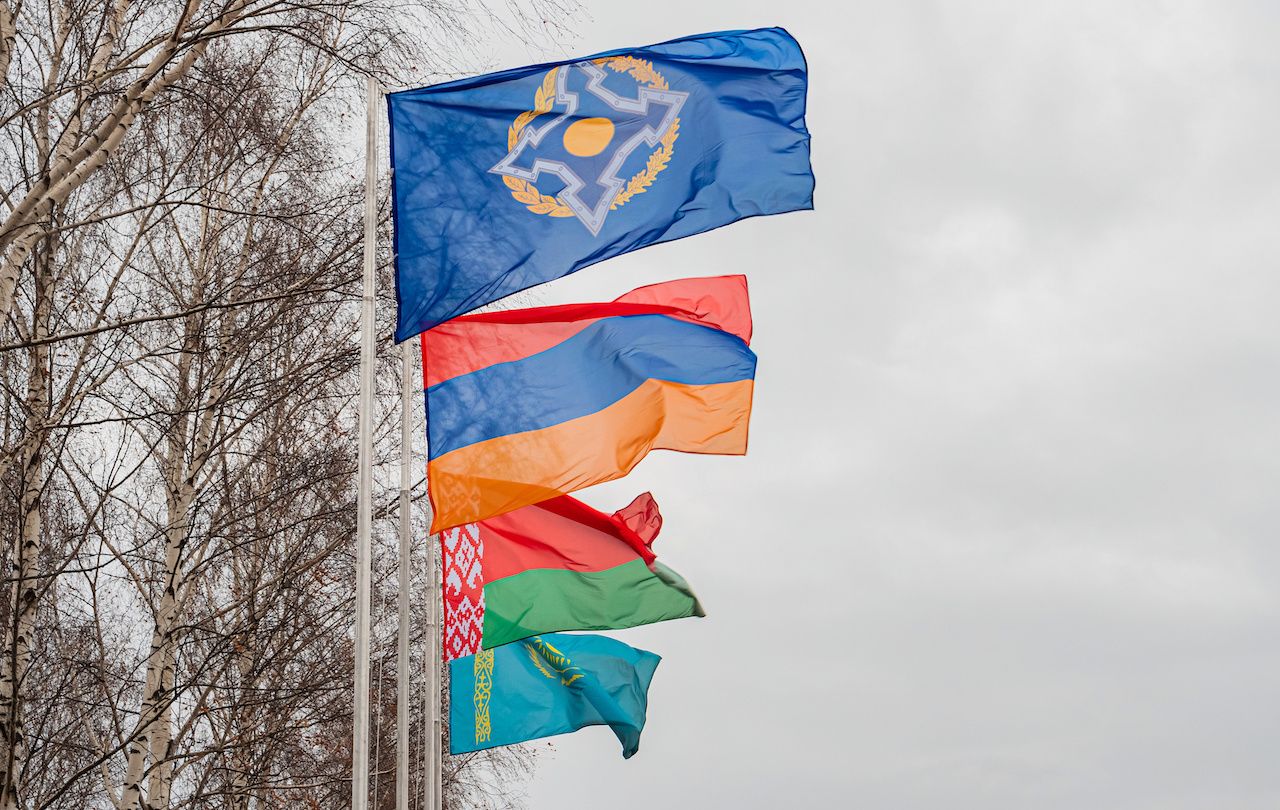
Armenia's prime minister will not file for divorce from the Collective Security Treaty Organisation (CSTO), the Kremlin-led security bloc that binds together Russia and five of its neighbours. Instead, he tells parliament he would be delighted if his partner threw him out. "I would be very happy if the organisation made a decision to expel Armenia," he said on August 27th, presenting his government's programme for 2026-2031, a document in which the CSTO does not merit a single mention.
It is, in diplomatic terms, the equivalent of leaving one's socks on the floor and waiting to be told to move out. Perhaps a strong strategy. By declining to use the withdrawal clause enshrined in his country’s Constitution, Mr Pashinyan has managed to distance himself from taking on any of the political and legal responsibility for tearing apart a security structure that has been the cornerstone of Armenia’s national defense doctrine for decades.
This is where the bureaucracy comes into play, as the CSTO itself provides an elegant way out via the organization’s own machinery, which reports that Armenia has been in arrears with its payments to the alliance for two years running, and that the CSTO’s secretary-general, Taalatbek Masadykov, has confirmed that discussion of a decision to suspend Yerevan’s voting rights could take place during the meeting of the heads of state in Moscow in November of this year. "Let us not anticipate events," says the CSTO's secretary-general, in the diplomatic equivalent of staring at the ceiling. The neatness of procedure works well for everyone except those who crave clarity.
The CSTO was frozen by Armenia way back in February 2024 due to its failure to come to the aid of Armenia in the face of the confrontation between Armenia and Azerbaijan. However, Mr Pashinyan has been turning up the heat steadily: first with his assertion that relations with the CSTO have "passed the point of no return" and now with the official start of the application process for joining the European Union, authorized by Armenia's Parliament in March 2025. Pivot rhetoric fails to match balance sheet reality.
Armenia still belongs to the Russian trade union, the Eurasian Economic Union, and Russian companies own dominant positions in its railway sector and in its only nuclear power station and parts of its energy sector, at least for now. The prime minister could declare himself free of the treaty organization in a speech to parliament, but freeing a landlocked nation of three million from the control of Russia over its pipelines, tracks, and transformers takes on a totally different complexion. The authorities in Yerevan are well aware of this.
So, evidently, is the Kremlin, whose spokesman, Dmitry Peskov, reacted not to Mr Pashinyan's rant with horror, but with something quite close to amusement, saying that Armenia was perfectly free to leave, and adding that any attempts to join the EU would inevitably result in bringing Armenian laws into compliance with European standards, something which “would harm Armenia itself.” The second line of defence for Moscow is more subtle. In the interview with TASS, Mr Masadykov was careful to differentiate “the position of the country’s leadership” from “that of the Armenian people”, indicating that the Pashinyan administration is a temporary phenomenon and not a reflection of genuine national feelings. This is a well-known tactic on the part of the Kremlin, applied whenever a neighbouring state strays from its sphere of influence: paint the elected leadership as a temporary deviation and wait for the popular mood, actual or fabricated, to prevail.
Extract — continue reading at the source.