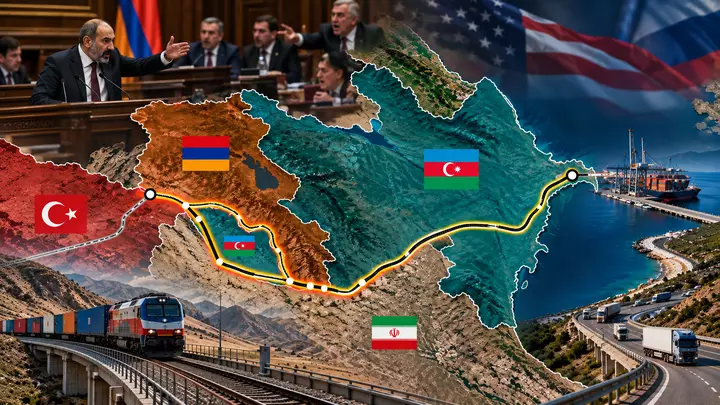
For a road that has not yet been fully built, the Trump Route for International Peace and Prosperity has already become a remarkably busy political battlefield. Armenia's parliament has approved the American-backed scheme to reconnect the South Caucasus. Its opposition, meanwhile, appears determined to treat the prospect of opening a border as another reason to keep the argument alive.
On October 28th, the Armenian National Assembly approved the Armenian-American TRIP idea with 63 votes to 32 (ten MPs abstained). Of the total 63 MPs who took part in the vote, all belonged to the dominant Civil Contract party. Those voting against the measure were 32, and they belonged to the two leading opposition parties, while 10 deputies did not take part.
In an earlier vote on the document of Donald Trump’s “Peace Council” [e.g., Board of Peace], the same chamber had unanimously supported it with a vote of 90 to zero. Opposition leader Anna Grigoryan of the Armenia faction argued that, although the agreement is formally between Yerevan and Washington, Azerbaijan's interests are more clearly represented than Armenia's. She questioned reciprocal customs treatment and demanded credible estimates of potential revenues.
Strong Armenia's Narek Karapetyan advanced a different objection: why implement TRIPP before Azerbaijan signs the bilateral peace treaty? They are different cases altogether. While asking about who holds the power to control the border and who gains from the lengthy concession might be proper parliamentary inquiry, making every progress toward connectivity dependent on settling each and every outstanding diplomatic issue could be counterproductive and create the same deadlock that divided the region for decades.
Speaker of Parliament Ruben Rubinyan stated the government’s position succinctly: it is really positive that the implementation of TRIPP is independent of the signing of the peace treaty. There are both practical and political aspects to this statement. If reconciliation cannot move forward until the very last stage of its legal completion is reached, then the small confidence-building measures leading up to the signing of the treaty remain elusive indefinitely.
The issue of sovereignty should not be reduced to rhetoric. The Armenia-US framework, which was officially published, clearly ensures the supremacy of Armenian control over policing, border security, customs, immigration, taxation, and official statistics. Armenia has the right to authorize an infrastructure security plan, and any private security personnel will have to be licensed in Armenia.
Extract — continue reading at the source.