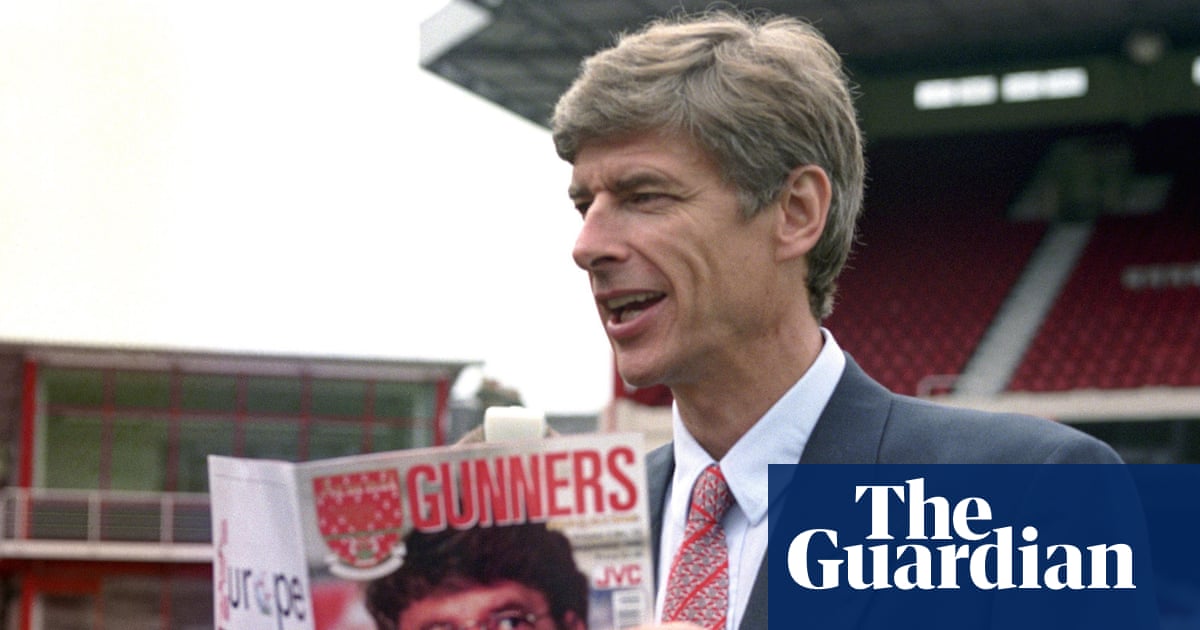
As feedback goes, even a character as relentlessly optimistic as David Dein might have considered the reaction to his bold managerial appointment suboptimal. Thirty years ago, Arsenal were in a state of chaotic flux, having sacked Bruce Rioch, with the interims Stewart Houston and Pat Rice in charge. There had been talk of Johan Cruyff arriving and Dein wanted to fill the information vacuum.
Summoning the team, he reassured them a new manager would soon be appointed and that he was a world-class addition. A brief pause ensued before a player’s voice called out: “Who the fuck is he?” His exclamation echoed conventional wisdom. Ultimately Dein’s decision was arguably the most seismic managerial appointment in modern English football history, not only providing proof that a foreign manager could succeed in this country but also ushering in an irreversible era of multiculturalism, giving birth to the globalised Premier League we know today.
Wenger described the Arsenal dressing room he inherited as “culturally English” and set about making his first signings, the characteristically unknown Frenchmen in Patrick Vieira and Rémi Garde; when he departed the job in 2018, every Premier League dressing room was a veritable United Nations. He was the trailblazer, preceding Gérard Houllier and Rafael Benítez at Liverpool and, ironically given their mutual animosity, José Mourinho at Chelsea, all beneficiaries of his success. On the flip side, there would never have been Tottenham’s ill-advised experiments with Christian Gross and Jacques Santini were it not for Wenger.
Undoubtedly he was the right man at the right time: Chelsea were already embracing the continental drift, having appointed Ruud Gullit, and Wenger’s arrival chimed with contemporary geopolitics. Tony Blair was about to become prime minister and a wave of European Union migration was coming; Polish plumbers and French footballers alike. Equally, Sky TV’s money was making England the best-paid country for footballers.
The first non-British or non-Irish manager in the top flight had been Dr Jozef Venglos, appointed by Aston Villa in 1990, ticking all the boxes of English football’s old prejudices: foreign, academic, whimsical, tactical. Gratifyingly for sceptics, he was an utter failure. Wenger seemed to fit the Venglos mould.
Nicknamed Le Professeur (because he wore glasses and spoke five languages), his captain, Tony Adams, thought him a “geography teacher”, while Ian Wright noted his clumsiness and dubbed him Clouseau, taking delight in pranking him about a bomb scare. Yet even the bastions of the English game acknowledge the magnitude of Wenger’s contribution. Wenger’s genius was in maintaining an English core to his early side, grafting on Vieira, Emmanuel Petit, Marc Overmars and allowing Dennis Bergkamp to flourish.
Extract — continue reading at the source.