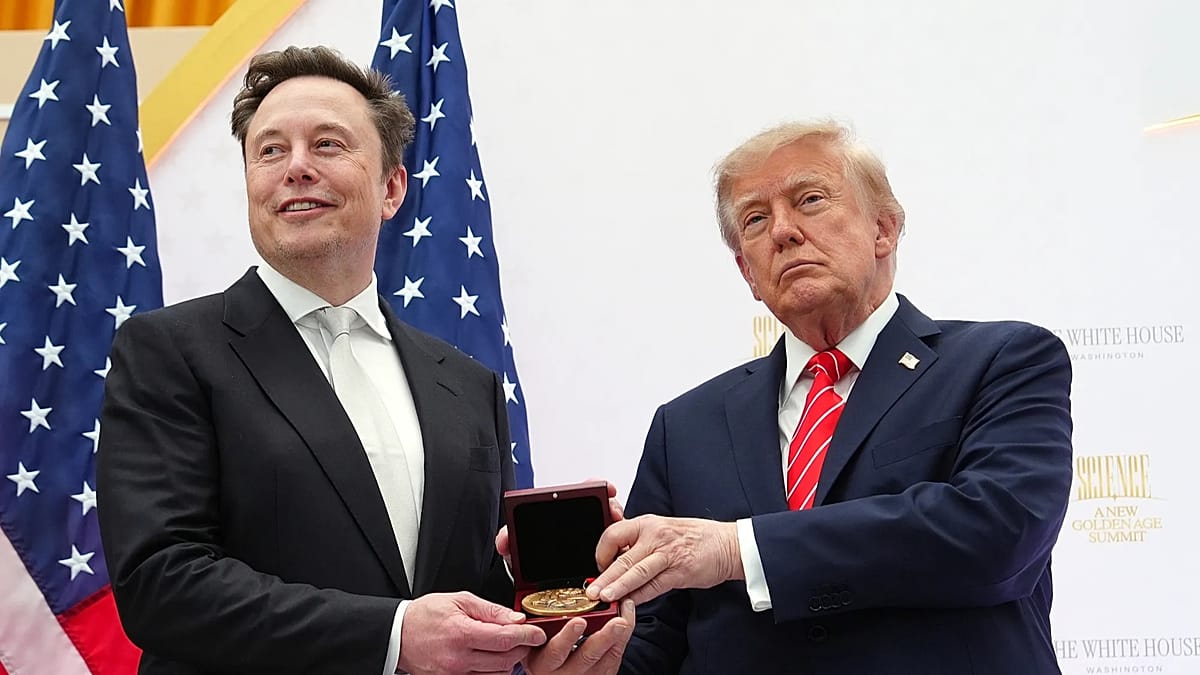
The Artemis II astronauts who flew around the moon in April received the US’s highest space honor on Friday. Donald Trump presented the Congressional Space Medal of Honor to the three Americans and one Canadian whose lunar flyby for the US space agency Nasa set a new distance record for humanity. Nasa’s administrator, Jared Isaacman, and other dignitaries took part in the packed ceremony at Houston’s Johnson Space Center, home to mission control.
The president used the occasion to announce the creation of a US space academy for the nation’s space force as well as Nasa and the commercial space community. Cmdr Reid Wiseman, pilot Victor Glover, and mission specialists Christina Koch and Jeremy Hansen, a Canadian, became the first astronauts to travel to the moon in more than half a century, coming within 4,067 miles (6,545km) while test-driving Nasa’s new Orion capsule. They were the first to launch onboard Nasa’s new moon rocket, a 30-story behemoth that had soared only once before from Florida’s Kennedy Space Center.
While they didn’t stop at the moon, the four set the stage for next year’s Artemis III docking rehearsal in orbit around Earth. Artemis IV’s moon landing by two astronauts, near the lunar south pole, could follow as soon as 2028. Trump said Americans will land back on the moon before his second presidency ends.
Mars is next – “very shortly”, he said. The president called the newest recipients “four intrepid space heroes”. He pointed out that they did not do it alone, thanking all who contributed to the Artemis II mission.
Wiseman and his crew are in good company, with only 30 astronauts receiving the prestigious honor before them. Many of the recipients were honored posthumously following their spaceflight-related deaths. Apollo 11 commander Neil Armstrong – whose phrase “that’s one step for man, one giant leap for mankind” gripped the world when he became the first person to walk on the moon on 20 July 1969 – was the first to receive the Congressional Space Medal of Honor.
President Jimmy Carter awarded six of these medals in 1978, which also went to Alan Shepard, the first American in space; John Glenn, the first American in orbit; and Apollo 8 commander Frank Borman, whose 1968 mission marked humanity’s first lunar voyage. The most recent recipients were Doug Hurley and Bob Behnken, the first astronauts to launch aboard a SpaceX rocket. Coming nine years after the space shuttle program’s close, their 2020 test flight to the International Space Station restored the US’s ability to launch crews from home soil.
Extract — continue reading at the source.