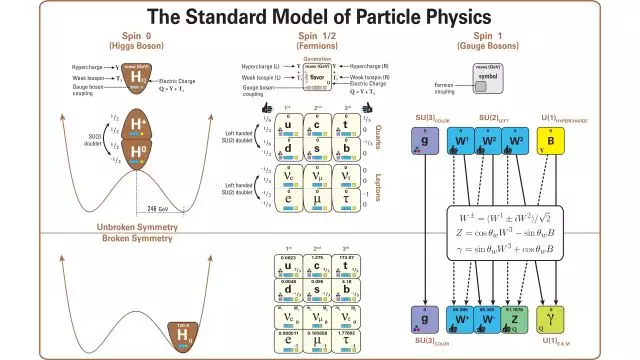
One of the great quests in all of science is to discover, at a fundamental level, what the Universe is actually made of. If you took every amount of matter and energy that existed — or even could exist — and cut it up into its smallest possible chunks, until only something that was uncuttable was left, you’d be left with the fundamental, elementary particles that composed our Universe. In physics, this took us first down to the level of the atom, then to atomic nuclei and electrons, then to protons, neutrons, and electrons, and finally to our modern Standard Model of elementary particles: complete with quarks, charged leptons, neutrinos, their antimatter counterparts, the gluons, the photon, the W-and-Z bosons, and one additional unique particle, the Higgs boson.
Of all of those particles, the Higgs boson is the most recently discovered particle: found only at particle accelerators, like the Large Hadron Collider at CERN, in 2012. But what’s the story of the Higgs boson? What makes it so unique, where does it come from, and how does it fit in with everything else that we know?
That’s what Vu H Nguyen wants to know, asking: “Can you explain the Higgs boson in depth? [It is] difficult for me to understand, but I think this is very important in particle physics. Maybe you can explain it in an easier way?” When we think about matter, we normally think about “fundamental” in the way we outlined above: by cutting it up into its smallest indivisible component parts. But there’s more to the story, and the Higgs boson requires us to go deeper than any other known particle in order to understand it.
From macroscopic scales down to subatomic ones, the sizes of the fundamental particles play only a small role in determining the sizes of composite structures. Whether the building blocks are truly fundamental and/or point-like particles is still not known, but we do understand the Universe from large, cosmic scales down to tiny, subatomic ones. The scale of electrons, quarks, and gluons is the limit to how far we’ve ever probed nature: down to scales of ~10^-19 meters, where these structures remain point-like.
Here in our Universe, we’re mostly familiar with the particles that are common and stable today: atoms and the subatomic particles they’re composed of. Atoms are made of electrons that orbit the atomic nucleus, which in turn is made of protons and neutrons, which themselves are made of quarks and gluons. If you want to see what types of quarks are in there, however, you have to collide particles together.
You have to collide them hard enough to break inside the atom, to crack open the atomic nucleus, to split apart the individual protons and neutrons, and to smash them directly into individual elementary particles. Four times a year, the Big Think print magazine shows up at your door. Big ideas from the world's biggest thinkers.
Extract — continue reading at the source.