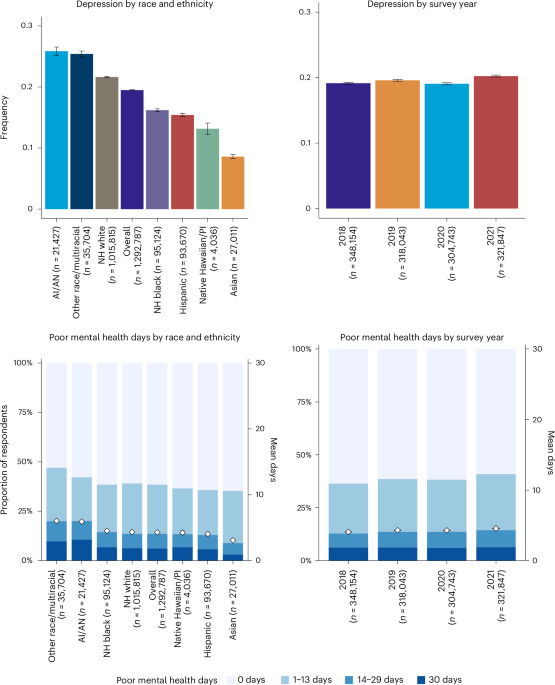
Cultural racism, the ideologies, values and systems that enable racial oppression, remains underexplored in relation to mental health. Using the Behavioral Risk Factor Surveillance System dataset between 2018 and 2021, we linked an empirical cultural racism factor derived from seven state-level indicators to mental health among 1,292,787 US adults (weighted 52.2% women); overall, 19.5% reported a history of depression, and respondents averaged 4.3 poor mental health days monthly. Here we show that each one unit (s.d.) increase in cultural racism factor was associated with higher risk for depression (3% overall; up to 25% among Native Hawaiian/Pacific Islanders) and poor mental health days (3% overall; up to 14% among Hispanics).
Associations were strongest among racial minorities and adults under 65 years and did not differ significantly by sex. These findings suggest that cultural racism may contribute to psychological distress, underscoring the need for further research and policy action. This is a preview of subscription content, access via your institution Receive 12 digital issues and online access to articles Prices may be subject to local taxes which are calculated during checkout The data that support the findings of this study are openly available online.
BRFSS data for 2018–2021 are available via the Centers for Disease Control and Prevention at https://www.cdc.gov/brfss/annual_data/annual_data.html. Data for the main exposure, cultural racism, are publicly available via Zenodo at https://doi.org/10.5281/zenodo.15609627 (ref. 70). Total population and income below poverty data are available via the US Census Bureau’s American Community Survey tables for 2017 at https://www.census.gov/programs-surveys/acs.
Gini coefficient data are available via US state-level income inequality updates by Frank (2014) at https://www.shsu.edu/eco_mwf/inequality.html (ref. 57). Population density data are available via the US Census Bureau’s 2010 Decennial Census at https://www.census.gov/programs-surveys/decennial-census. National Institute of Mental Health https://www.nimh.nih.gov/health/statistics/major-depression (2023).
Changes in prevalence of mental illness among US adults during compared with before the COVID-19 pandemic. Handy, A., Mangal, R., Stead, T. Prevalence and impact of diagnosed and undiagnosed depression in the United States.
Cureus. 14, e28011 https://doi.org/10.7759/cureus.28011 (2022). Article PubMed PubMed Central Google Scholar Goldman, N., Glei, D. Declining mental health among disadvantaged Americans.
Extract — continue reading at the source.