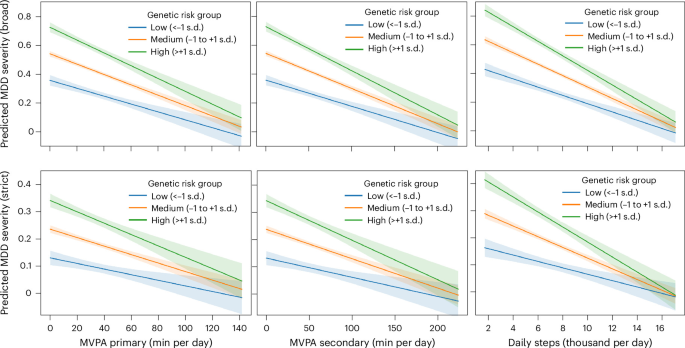
Both genetic liability and physical activity (PA) are well-established contributors to major depressive disorder (MDD), yet large-scale studies integrating device-assessed PA with genomic risk remain limited, and prior gene–environment research has focused almost exclusively on MDD onset rather than symptom severity. We analyzed 23,517 participants from the All of Us Research Program (mean age, ~56 years; range, 18–92 years; 67.2% female) with whole-genome sequencing and long-term Fitbit-derived PA data (mean wear time of 582 days). PA was operationalized using daily minutes of moderate-to-vigorous PA and steps, and MDD was defined using a dual-source phenotype combining electronic health records and self-reported lifetime diagnosis.
Here we examined both MDD diagnosis and electronic health record-derived symptom severity using regression models testing main and interaction effects of polygenic risk scores (PRSs) and PA, adjusting for demographic covariates. Across all PA metrics, a higher PRS was robustly associated with increased likelihood of MDD diagnosis, whereas higher PA was associated with lower risk; however, no significant PRS × PA interactions were observed for MDD onset. By contrast, for symptom severity, both PRS and PA showed significant main effects, and consistent negative interactions emerged across all PA operationalizations and different severity definitions, indicating that higher PA attenuated the association between genetic risk and depressive symptom burden.
These interaction patterns were robust across different model specifications. Together, these findings suggest that genetic and behavioral factors contribute largely independently to MDD onset but interact in shaping symptom expression, highlighting PA as a potential modifier of genetic vulnerability in depression and a potential target for precision mental health interventions. This is a preview of subscription content, access via your institution Receive 12 digital issues and online access to articles Prices may be subject to local taxes which are calculated during checkout The individual-level data used in this study are available through the NIH All of Us Research Program Researcher Workbench.
These data are subject to controlled-access requirements and cannot be redistributed by the authors. Eligible researchers can apply for access to the All of Us data by registering with the Researcher Workbench and completing the required data access and training procedures. The present study used the Control Tier dataset version 8 (C2024Q3R4).
Analyses were conducted using publicly available software, including PLINK 2.0 and SBayesRC, as described and cited in Methods. No proprietary software was used. Custom code used for data processing, phenotype construction and statistical analyses in this study is available via Zenodo at https://doi.org/10.5281/zenodo.21925862 (ref. 78).
GBD 2019 Diseases and Injuries Collaborators Global burden of 369 diseases and injuries in 204 countries and territories, 1990–2019: a systematic analysis for the Global Burden of Disease Study 2019. Lancet 396, 1204–1222 https://doi.org/10.1016/S0140-6736(20)30925-9 (2020). Genome-wide meta-analysis of depression identifies 102 independent variants and highlights the importance of the prefrontal brain regions.
Extract — continue reading at the source.


