Disrupted axonal transport and astrocyte dysfunction are implicated in amyotrophic lateral sclerosis (ALS). Here we show these processes are linked—human-induced pluripotent stem-cell-derived astrocytes carrying the C9ORF72 mutation disrupt mitochondrial axonal transport and mitochondrial function in cocultured motor neurons (MNs). Conversely, isogenic gene-corrected astrocytes or boosting astrocytic mitochondrial bioenergetics rescue axonal mitochondrial transport deficits in C9ORF72 MNs.
Our results delineate a non-cell-autonomous role for astrocytes in regulating mitochondrial transport along axons in ALS models. Amyotrophic lateral sclerosis (ALS) is a progressive, incurable and fatal neurodegenerative condition. Mutation in the C9ORF72 gene is the commonest cause of familial ALS and accounts for ~10% of sporadic cases.
Axonal transport of cargo such as mitochondria is critical for neuronal function and survival1,2, and its disruption is increasingly implicated in ALS3. Mitochondrial dysfunction and impaired motility occur in C9ORF72 MNs4,5,6, where restoring mitochondrial function rescues transport6. Astrocytes regulate neuronal metabolism and contribute to non-cell-autonomous neurodegeneration7,8, through mechanisms including reduced glutamate uptake, defective lactate shuttling and impaired mitochondrial substrate transport9,10.
However, their role in regulating axonal transport remains unknown. Against this background, we used human stem-cell-derived models to address whether and how astrocytes regulate axonal mitochondrial transport in C9ORF72-ALS. We uncovered an astrocyte-mediated mechanism that controls axonal transport and found that boosting astrocytic mitochondrial metabolism is sufficient to reverse transport deficits in C9ORF72 motor neurons (MNs).
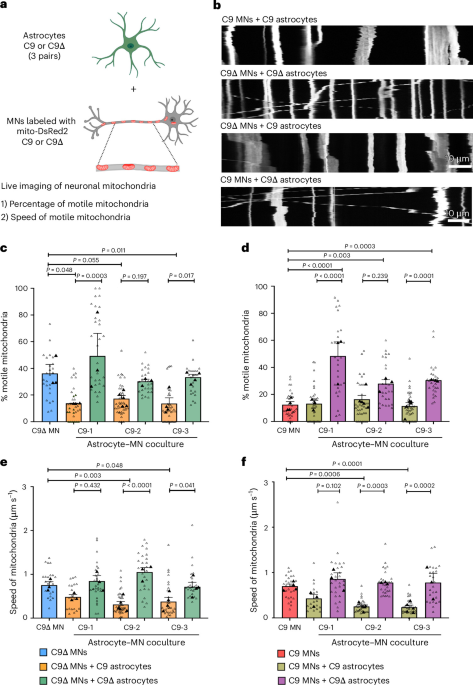
To evaluate cell-autonomous and astrocyte-derived non-cell-autonomous effects of the C9ORF72 mutation on axonal mitochondrial transport in MNs, we performed live imaging of mitochondrial transport in MNs, both in isolation and in coculture with astrocytes. We used three patient-derived human-induced pluripotent stem cell (hiPSC) lines carrying the C9ORF72 mutation (C9) and their gene-corrected controls (C9Δ) generated through CRISPR–Cas9 (ref. 11), to produce highly enriched spinal cord-patterned astrocytes expressing >90% glial fibrillary acidic protein and S100B (Extended Data Fig. 1). As we previously published, notwithstanding that these astrocytes show key C9ORF72-related pathological features, such as RNA foci and dipeptide repeat proteins, they show no difference in their ability to take up extracellular glutamate and propagate calcium waves11.
Separately, C9 and C9Δ iPSCs were differentiated into enriched spinal cord-patterned neuronal cultures (>90% neurons) of which 50–60% were ISL 1/2-positive MNs and devoid of astrocytes, as previously described6,12. C9 MNs and C9Δ MNs were examined in monocultures or in coculture with the three pairs of C9 and C9Δ patient-derived astrocytes (C9-A or C9Δ-A). We measured two established features of axonal mitochondrial transport—the percentage and average velocity of motile mitochondria.
Extract — continue reading at the source.


