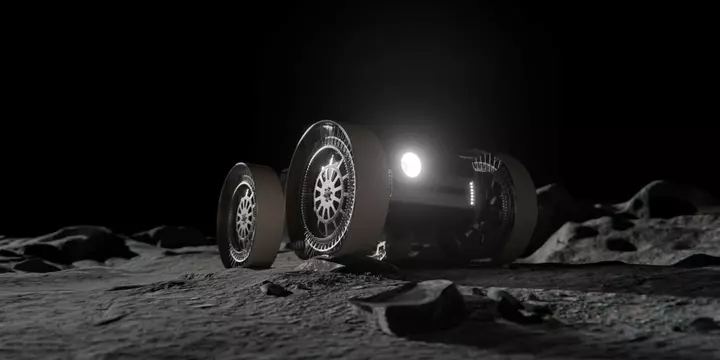
A computer capable of running AI software is one of the payloads aboard Astrolab’s FLIP lunar rover, which is slated to head to Earth’s celestial companion as early as November 2026. The 480-kilogram FLIP rover, short for “FLEX Lunar Innovation Platform,” is the first in a series of vehicles NASA has contracted from Astrolab, including future buggies that will move Artemis astronauts across the moon’s surface. Fitted with deformable wheels engineered for the rugged terrain and designed to survive at least 150 hours of the frigid lunar night, FLIP will carry 20 scientific payloads, including a lidar 3D mapper and a sensor to measure concentrations of the isotope helium-3 in lunar regolith.
The rover will also carry a high-performance computer made by HPE that will be the first to run LLMs on the moon’s surface. Such software could ultimately help enable greater autonomy and real-time intelligent decision-making in space on future missions, eliminating the time delays and limited bandwidth that often plague long-distance communications between ground control on Earth and robots elsewhere in the solar system. In fact, the Soviets lost two rovers in the past because of operator errors caused by the time delay.” During FLIP’s mission, specialized custom-built LLMs will run a series of experiments to prove that the technology can operate reliably in the extreme environment of the moon.
They will analyze data from the onboard cameras and the lidar mapper to aid with safe navigation in the lunar terrain and distill insights it gleans from the gathered data, reducing the amount of information the rover needs to transmit back home. China’s Chang’e-6 rover, which landed on the far side of the moon in 2024, used basic AI algorithms and neural networks for autonomous navigation. Similarly, NASA’s Mars rovers Curiosity and Perseverance have been driving semiautonomously using pre-programmed paths for years, but the space-hardened computer brains these rovers rely on are remarkably weak, comparable to late 1990s laptops.
FLIP’s HPE Spaceborne-4 edge computer, on the other hand, consists of a high-performance 64-bit CPU combined with a GPU that can run large numbers of computational tasks in parallel, just like advanced edge computers on Earth. HPE has previously sent three Spaceborne computers to the International Space Station to test the technology in the milder and more controlled environment of low Earth orbit. The Spaceborne-2 and Spaceborne-3 computers, launched in 2021 and 2024, respectively, ran Meta’s Llama 3.2 LLM aboard the ISS as part of the “Space Llama” initiative in 2025, helping astronauts to streamline research tasks and speed up crew’s decision-making.
When radiation spikes, the software can lower the computer’s power and speed to reduce risk to the electronics, ensuring that the system remains reliable for extensive periods of time. With the moon, however, HPE has signed up for an entirely new level of challenge. Inside the space station, the Spaceborne computers operate in relative comfort.
While temperatures aboard the ISS hover around 20 °C, FLIP will land near the lunar south pole, where temperatures can swing between scorching 80 °C in sunlit areas and frigid -200 °C in shaded regions, which FLIP will search for the presence of water ice. The cosmic radiation lashing the moon’s surface is almost three times as intense as that inside the shielded space station, which also benefits from the protection of Earth’s magnetic field. Yet FLIP’s Spaceborne-4 computer remains remarkably simple.
Extract — continue reading at the source.