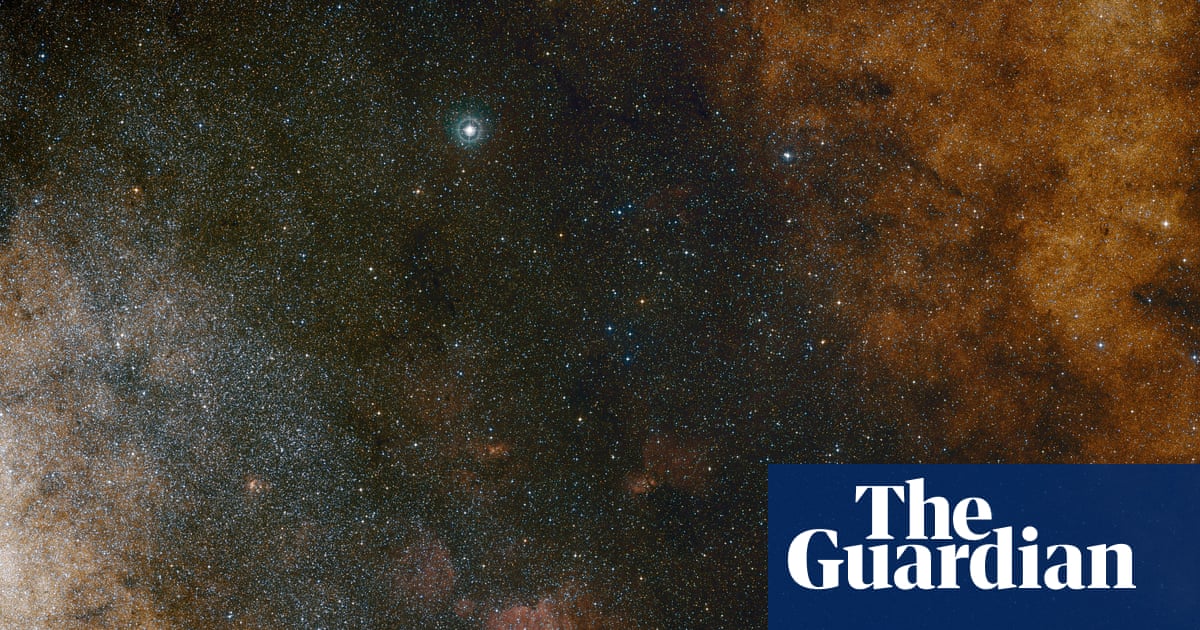
Astronomers have detected the fastest known star in the Milky Way, hurtling around the supermassive black hole at the heart of the galaxy. The star, called S301, travels at about 25,000km (15,500 miles) per second, 100,000 times faster than a commercial plane. It is also the closest known star to the Milky Way’s central black hole, Sagittarius A*, approaching it around the distance of Saturn to the Sun.
That is unprecedented,” said Felix Mang, a PhD student at the Max Planck Institute for Extraterrestrial Physics (MPE) in Garching, Germany, and an author of the study published on the findings. The star’s extreme proximity to Sagittarius A* means that it could open a new window on to the black hole’s fundamental properties and the extreme environment surrounding it. Like many objects in the night sky, black holes are predicted to spin.
According to Einstein’s general theory of relativity, a spinning black hole drags spacetime along with it, warping the orbits of surrounding stars. This effect is only meaningful for objects orbiting fast-rotating black holes at close range. S301 appears to have the perfect combination of a highly eccentric (lopsided) and very tight orbit.
Previously it had been assumed it would require measuring the motion of multiple stars for several decades to estimate the spin of Sagittarius A*. The scientists were able to trace S301’s orbit back to 2017 and, by tracking it through its next closest passage in 2031, hope to have enough data. The observations were made using the European Southern Observatory’s Very Large Telescope Interferometer (ESO’s VLTI) at the Paranal Observatory in Chile, which combines the light from four 8-metre telescopes.
Although the star is unusually close to the central black hole, it is not expected to cross its event horizon, the point beyond which objects can never escape. It’s not really much different from something orbiting the sun and it’s going to remain on this orbit.” Dr Ziri Younsi, an astrophysicist at University College London, who was not involved in the observations, said: “This is incredibly important as a discovery. It’s very exciting because this thing comes insanely close to Sagittarius A* and it’s travelling, at its peak, at about 8% of the speed of light, which is crazy.” Younsi said that using the orbit to provide a measurement of the black hole’s spin would be a gamechanger for understanding the evolution of the Milky Way.
Extract — continue reading at the source.


