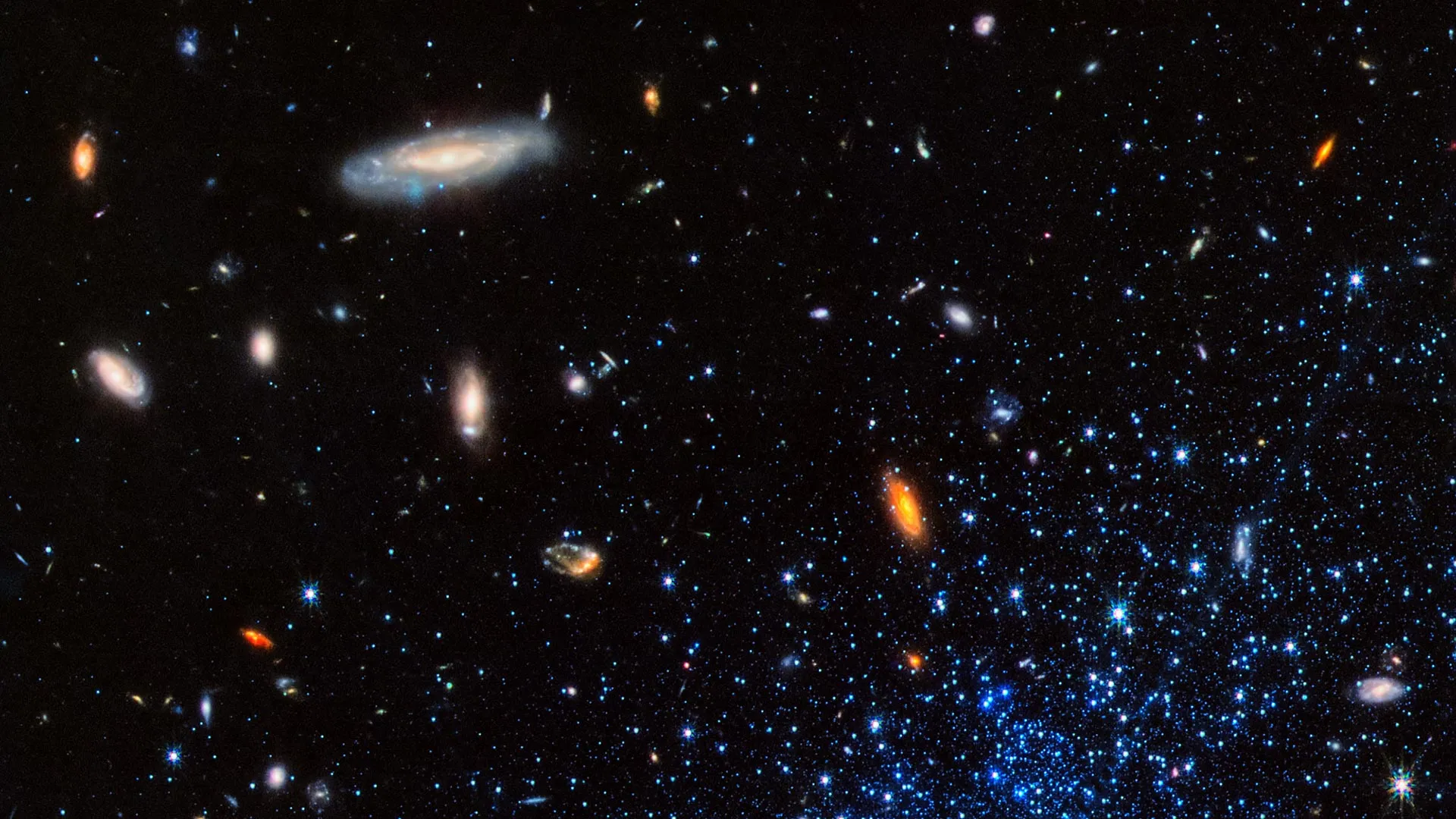
Scientists have measured the amount of helium produced during the Universe's first five minutes with unprecedented precision, offering a clearer picture of the conditions that existed shortly after the Big Bang. The achievement, made by an international research team that includes scientists from the University of Minnesota Twin Cities, represents a major advance in precision cosmology. The findings, presented in five papers published in The Astrophysical Journal, are based on 130 hours of observations using the Large Binocular Telescope.
By analyzing distant galaxies, the researchers reduced the uncertainty in this fundamental measurement to just 0.5%, making it three times more precise than previous estimates. The improved accuracy provides scientists with a powerful new tool for investigating the origins of the Universe and testing the Standard Model of physics. Such fundamental tests have a long history of advancing scientific understanding and contributing to technological breakthroughs.
"This is a physics experiment on a grand scale and one of the biggest findings in my entire 40-year career," said Evan Skillman, University of Minnesota College of Science and Engineering Distinguished Professor in the School of Physics and Astronomy. "It's a fundamental number that tells us specifically about the conditions of our Universe in its first five minutes. It has diagnostic power that speaks directly to the Standard Model of Physics." According to the Big Bang theory, the Universe began expanding from an extraordinarily hot, dense state approximately 13.8 billion years ago.
Three major lines of evidence support this explanation: the continuing expansion of the Universe, the cosmic microwave background radiation, and the amounts of light elements such as helium and deuterium that formed during its earliest moments. Although cosmic expansion and the microwave background have been studied extensively, measurements of primordial helium have historically received less attention. Determining its original abundance more accurately allows researchers to investigate the physical conditions that prevailed when the Universe was only minutes old.
To achieve their new level of precision, the team departed from the conventional method of estimating primordial helium. That approach involves observing large numbers of galaxies and extrapolating the results to determine how much helium existed before later generations of stars altered their chemical composition. Instead, the researchers selected 15 exceptionally pristine, small, distant galaxies.
These galaxies have undergone relatively little chemical evolution, making them valuable cosmic "time capsules" that preserve clues about the Universe's early composition. Powerful Telescopes Deliver Record Precision The team used sophisticated spectrographs developed at Ohio State University to examine more than 10 helium spectral lines and 15 hydrogen lines simultaneously. Studying these signals together made it possible to identify and correct subtle sources of measurement error that earlier studies could largely overlook.
Extract — continue reading at the source.


