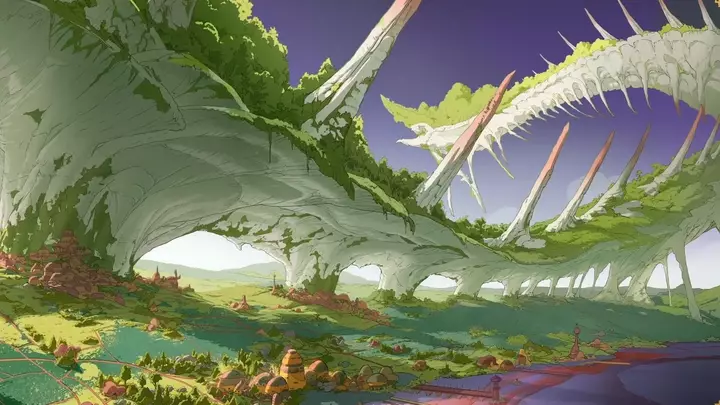
Avatar: Seven Havens offers a striking visual makeover to the world of bending. The new series drops the familiar look of The Last Airbender and The Legend of Korra in favor of post-apocalyptic alien landscapes filled with craggy orange mountains, sprawling deserts, and ominous green storms. Ancient, unidentifiable structures jut from the barren wasteland, hinting at a history that stretches far beyond the people now struggling to survive in it.
There is a haunting beauty to these environments, resembling the pages of an illustrated sci-fi epic rather than the remains of a traditional fantasy kingdom. One of the clearest artistic touchstones is French comic artist Jean Giraud, better known as Moebius, whom Avatar creator Bryan Konietzko mentioned as inspiration for the new series on stage at New York Comic Con 2026. Arzach and other works, particularly his contributions to the sci-fi anthology magazine Métal Hurlant, helped establish a visual language for alien worlds that feel simultaneously desolate and brimming with fascinating cultures.
Moebius frequently anchored his frames with solitary figures set against colossal landscapes, letting strange architecture and alien terrain tell the story without leaning on heavy exposition. This same philosophy feels central to Seven Havens, where the wilderness is much more than a mere obstacle for Pavi and Nisha to overcome; it’s a standing monument to a deep and lost history that predates them entirely. Moebius’ visual identity rests on crisp, ultra-precise line art paired with flat color gradients, a technique that makes impossibly alien worlds feel tactile yet dreamlike.
His landscapes rely on fine hatching, sheer scale, and bizarre geometric geology, where sharp sandstone arches, carved monolithic ruins, and endless pastel horizons dwarf his subjects. Seven Havens adopts this exact visual grammar, most strikingly in the presentation of Ellora and the sprawling Harshlands surrounding it. Rather than relying on painterly backgrounds, the show adopts clean linework and high-contrast palette shifts, framing wide shots where Ellora’s walled structures rise abruptly near sun-scorched canyons.
By surrounding these massive settlements with barren wastelands beneath ominous green-hued storm clouds, the series mirrors Moebius’ signature trick of using empty space to make the world feel ancient, mysterious, and eerily quiet, forcing the viewer's eye to drink in the sheer magnitude of a forgotten planet — or, in this case, the familiar world of bending. Moebius wasn’t the only influence on Seven Havens, of course, as co-creator Ethan Spaulding noted Hayao Miyazaki’s Nausicaä of the Valley of the Wind as another inspirational pillar during the NYCC panel. Nausicaä exists in a world where humanity clings to survival amid the remnants of a fallen civilization, surrounded by uncanny ecosystems that are as breathtaking as they are menacing.
Its landscapes invite awe rather than purely signaling danger, a quality that defines the visual identity of Seven Havens. Moreover, both Moebius and Miyazaki deeply admired one another, with Miyazaki frequently citing Arzach as a profound inspiration for his work. Their shared obsession with otherworldly environments makes them the ideal creative lineage for a series exploring life long after the end of the world.
Extract — continue reading at the source.