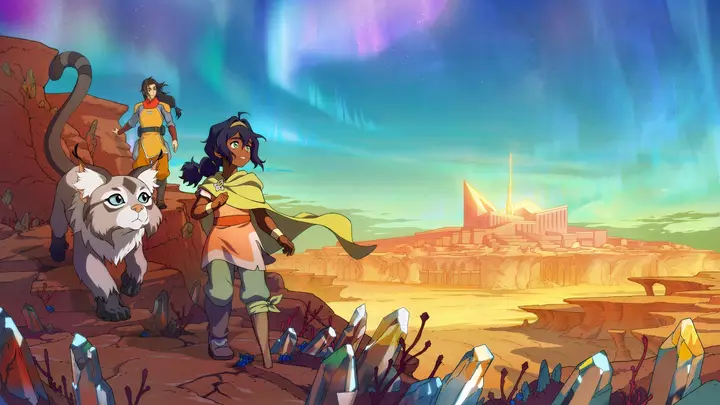
With Avatar: Seven Havens, the world of bending is entering an unfamiliar era. Set amidst the ruins of a civilization reshaped by a mysterious catastrophe, the new series expands the franchise's visual scope while bringing South Asian cultural influences further to the foreground. The result is a fantasy world that feels both distinctly Avatar and unlike anything we've seen before.
But if you're worried that Avatar: Seven Havens doesn't resemble the world you fell in love with in Avatar: The Last Airbender or The Legend of Korra, you can rest easy. Set in the aftermath of a cataclysm that has left the world in ruins, Seven Havens follows Pavi (Saheli Khan) and Nisha (Aishu Devan), twin sisters who discover they share the mantle of the Avatar in a world where civilization has been reshaped by disaster. As they navigate the seven surviving Havens, the sisters must grapple with a fractured world, the legacy of past Avatars, and the mysteries surrounding their extraordinary familial connection.
The series' post-apocalyptic setting allowed the creative team to rethink what the world of bending might look like after civilization had been cataclysmically reshaped. Concept art reveals a landscape of craggy orange mountains, sprawling deserts, and green storms gathering on the horizon. In one particularly striking image, a massive white structure covered in moss initially resembles a natural rock formation, until closer inspection reveals the skeletonized remains of an ancient creature.
It feels both fantastical and deeply unsettling, as though the landscape itself has become a canvas filled with nothing but the discarded remnants of the world that came before. Such immense devastation and imagery involving constant green storms inevitably invites comparisons to climate change, though co-creator Konietzko stressed this wasn't the original motivation behind the show's premise. We actually had this kind of post-apocalyptic idea right after the original series,” Konietzko said.
It's hard to do something like that without it reflecting what's going on in our world.” Konietzko acknowledged that the show's post-apocalyptic setting also carries real-world resonance. While the team didn’t explicitly set out to create a direct climate-change allegory, the showrunners welcome those comparisons. You can't take society and civilization for granted, and you can't take your environment for granted,” he said.
We all need to be thinking about those things and talking about them and acting on them.” Beyond its fractured landscape, the most radical evolution in Seven Havens lies in its core premise. For the very first time in the franchise, the mantle of the Avatar is split between two people, Pavi and Nisha. It’s an unprecedented pivot, yet co-creator DiMartino notes that this dual concept was actually one of the creative team's earliest foundational sparks.
Extract — continue reading at the source.