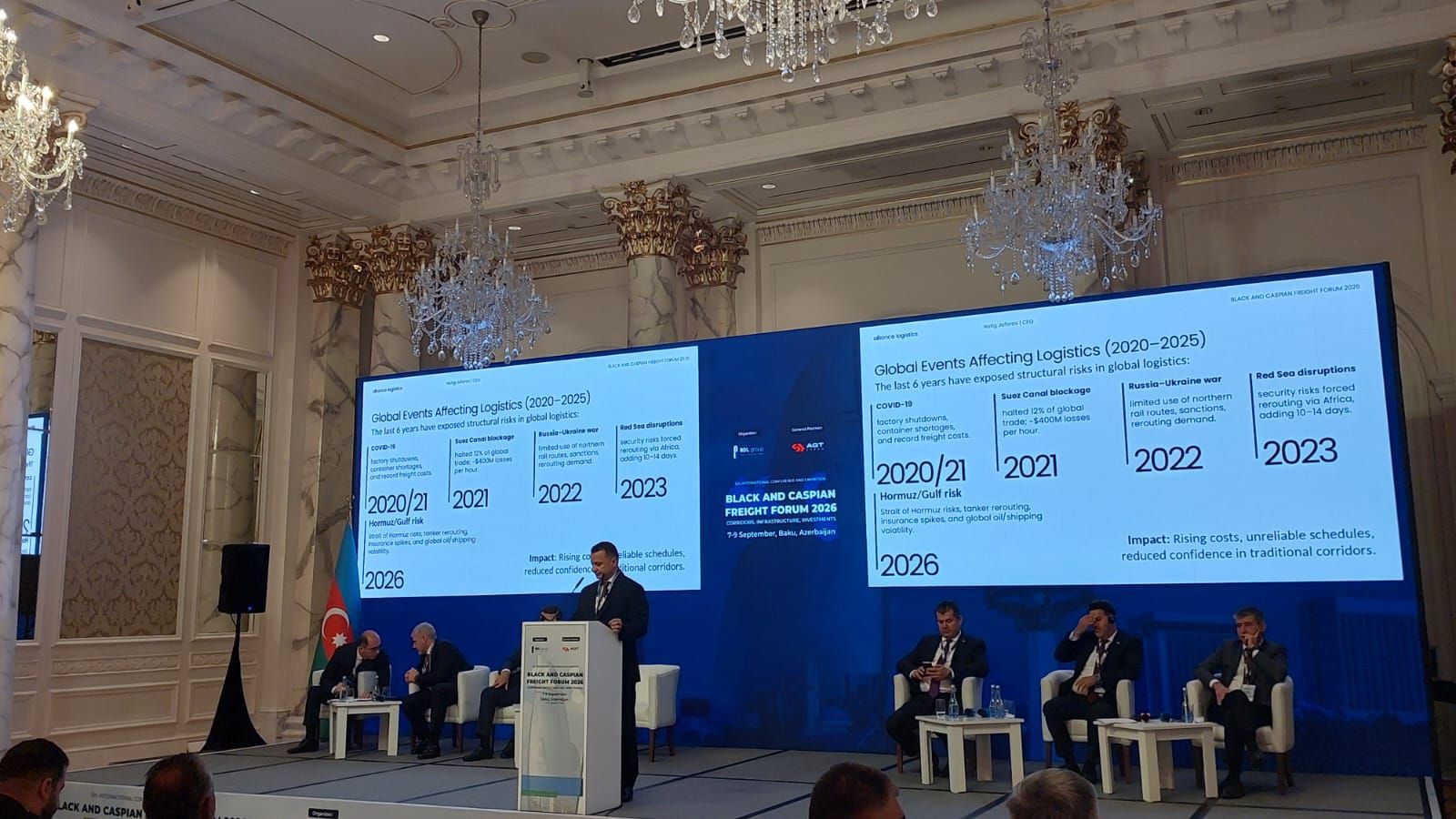
Azerbaijan’s geostrategic position and developing transport infrastructure are strengthening the country’s role as a major transit hub in the Black Sea-Caspian region, Natig Jafarov, CEO of Alliance Multimodal, said during the 5th International Conference and Exhibition, Black and Caspian Freight Forum 2026: Corridors, Infrastructure, Investments. Jafarov noted that Azerbaijan’s geographic location between major regional powers gives the country significant potential to serve as a key transport link between East and West. "Azerbaijan’s geopolitical situation owes [it] to be a major transport power in the region," he said, highlighting the importance of the Port of Baku as a central element of the country’s transport infrastructure.
He noted that Azerbaijan is connected to more than 33 countries through its transport network, with major routes linking the country to Georgia, Türkiye, Russia and European markets. Jafarov also highlighted the development of railway infrastructure and the expansion of the Baku-Tbilisi-Kars railway, saying that continued investment is aimed at increasing the capacity of regional transport corridors. According to him, the Baku-Tbilisi-Kars railway currently has a capacity of around 30,000 tons annually and noted that the line has already been expanded.
Turning to the maritime sector, he said that the Port of Baku currently has significant cargo-handling capacity, which is expected to increase further as infrastructure development continues. Jafarov pointed out that the Port of Baku currently has an annual handling capacity of around 150,000 tons, which is expected to increase to approximately 260,000 tons next year. At the same time, Jafarov stressed that infrastructure alone is not sufficient to ensure stable growth in regional transit.
"We are all aware of the global crisis and how it’s affecting us," he stressed, noting that instability in global trade and shipping has become a major challenge in recent years. According to Jafarov, disruptions in maritime transport have also affected freight rates. He noted that container shipping rates from China experienced significant fluctuations during and after the COVID-19 pandemic and were pushed higher again by subsequent disruptions in global shipping.
He added that the changing global trade environment makes the development of alternative transport routes increasingly important. Here we are to serve you with news right now. It does not cost much, but worth your attention.
Choose to support open, independent, quality journalism and subscribe on a monthly basis. By subscribing to our online newspaper, you can have full digital access to all news, analysis, and much more. You can also follow AzerNEWS on Twitter @AzerNewsAz or Facebook @AzerNewsNewspaper
Extract — continue reading at the source.