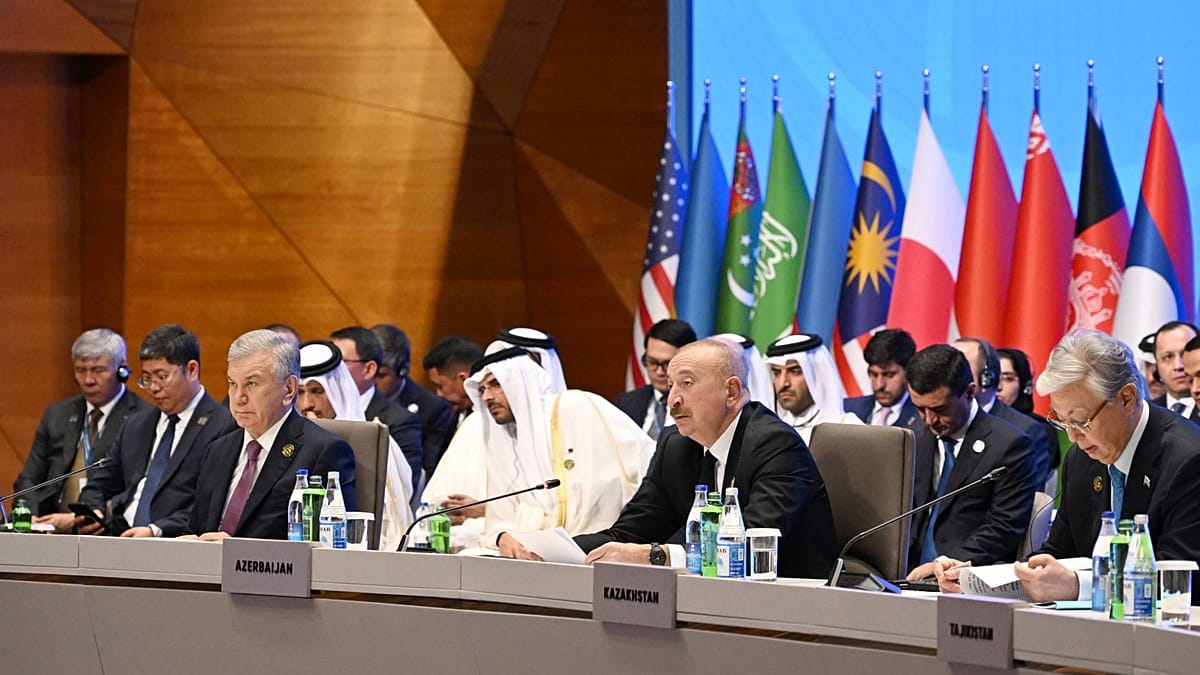
Leaders from across Asia and the Middle East including in-conflict countries met in Baku on Thursday to address their differences — leading to tense moments — but also to explore ways in which they can work together in the fast-evolving global climate of turmoil, both within the summit and in bilateral meetings. Azerbaijan’s President Ilham Aliyev engineered bringing opposing heads of state and government under the same roof, as well as those seeking political and economic alliances, in a regional organisation focused on "confidence-building measures". The summit hosted Israel President Isaac Herzog, Iran’s Deputy Foreign Minister Kazem Gharibabadi, Turkey’s Foreign Minister Hakan Fidan, Russia’s Foreign Minister Sergey Lavrov, Qatar’s Emir Sheikh Tamim bin Hamad Al-Thani, UAE Minister of State for Foreign Affairs Khalifa bin Shaheen Al Marar and a Palestinian delegation led by foreign minister Varsen Aghabekian Shahin who were joined by the presidents of Uzbekistan, Kazakhstan, Kyrgyzstan and Tajikistan as well as China's foreign minister Wang Yi and heads of state and governments from Laos, Cambodia, Vietnam, India and Sri Lanka.
The 7th Summit of the Conference on Interaction and Confidence-Building Measures in Asia (CICA), a multilateral forum aimed at promoting peace, security, and trust among Asian nations, focused on conflict resolution, transport connectivity, and digital transformation, with most leaders declaring their commitment to expand coordination across the Euroasian space. Aliyev said that as his country sits at the intersection of Asia and Europe, it "plays an increasingly important role as a connecting hub in the Eurasian space.” Kazakhstan's President Kassym-Jomart Tokayev said "our regions bring Eurasian countries together" and proposed a CICA transport connectivity strategy to increase transport links across Asia, arguing that economic cooperation can reduce tensions and build trust. "In this regard, Kazakhstan relies on partnership, and last year a strategic partnership document was signed between Kazakhstan, Azerbaijan, and Uzbekistan; by signing the documents laying the foundation for the creation of the Caspian green energy corridor in the field of green energy, ensuring the transmission of produced goods and services to the European market via the Black Sea," Tokayev said.
"This corridor document will also yield benefits via the Baku-Tbilisi-Ceyhan pipeline," he added. "The 21st century has already been called the Asian century. Whether it is called an era of peace or an era of separation and division, our responsibilities are still upon us, and based on joint measures, we can answer these challenges or achieve success," Tokayev said.
Azerbaijan and Kazakhstan's presidents also officially inaugurated the Trans-Caspian fibre-optic cable line on the Caspian seabed, which will increase digital connectivity between Asia and Europe from China and Central Asia towards Europe through the Black Sea as a key component of the wider strategic Middle Corridor project. Uzbekistan's President Shavkat Mirziyoyev called for "an infrastructure of trust in Asia" based on transport and energy projects which would prevent future conflicts. Underlining the role of CICA, Mirziyoyev said that "when dialogue weakens, the risk of wrong decisions being made increases.
We must strive to ensure that political disagreements do not turn into armed confrontations." Kyrgyzstan's President Sadyr Japarov said that according to UN reports, just this year 59% of global economic development will fall to Asia's share and as "international conflicts and technological transformation are accelerating, and ecological and climate risks are increasing." "The Kyrgyz Republic sees CICA as a platform serving the common interests of Asian countries," Japarov added. Vietnam's Vice President Võ Thị Ánh Xuân said, "We should also expand coordination between CICA, ASEAN, and other regional cooperation mechanisms, fostering closer links between Southeast Asia, Central Asia, and the wider Euro-Asian region." The ongoing conflicts in the Middle East and their consequences were a key theme of the summit, alongside the opportunities of global reshapes — yet not without tense moments. When Israel's Herzog began his address, delegations from Turkey, Iran, Kuwait, Pakistan and others left the hall, but the emir of Qatar and delegations from the UAE and Bahrain stayed to listen.
In his address, Herzog said his country focuses on "practical cooperation and pursues shared and mutual interests." "The presence here of representatives of the Kingdom of Bahrain and representatives of other Arab countries is at the center of our attention and commendable," he added. Noting US Secretary of State Marco Rubio's upcoming regional visit to Uzbekistan, Herzog reaffirmed Israel's commitment to practical cooperation in technology and water management, stating that "thanks to cooperation, there is no place for boycotts". Herzog, who arrived in Baku on an Azerbaijani jetliner to fly through Turkish airspace, held talks with his Azerbaijani and Kazakh counterparts during the summit, praising their "excellent relations".
Extract — continue reading at the source.