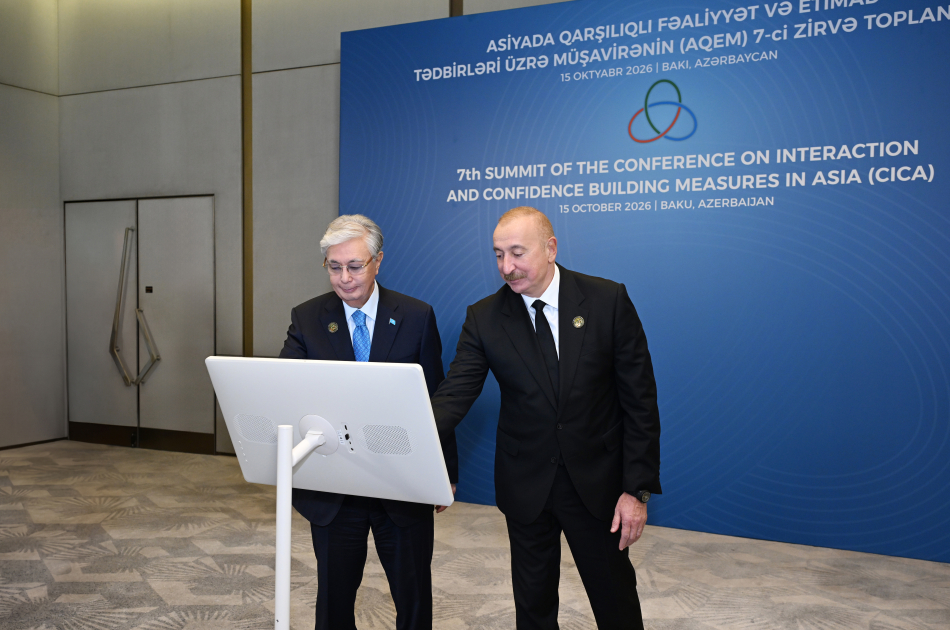
The Caspian Sea is becoming more than a link between Central Asia and the South Caucasus. It is emerging as a potential gateway for the digital traffic connecting Asia and Europe. That ambition was reflected in the 7th Summit of the Conference on Interaction and Confidence Building Measures in Asia (CICA), held in Baku, where regional cooperation and connectivity featured against a backdrop of shifting geopolitical alignments and growing concerns over the security of critical infrastructure.
The launch of the Trans-Caspian Fiber-Optic Cable Line by Azerbaijani President Ilham Aliyev and his Kazakh counterpart, Kassym-Jomart Tokayev, offers a concrete expression of that ambition. For years, much of the data traffic between Asia and Europe has depended on routes running through Russia or via the Middle East and the Red Sea. Disruptions to undersea cables have exposed the vulnerabilities of existing networks, strengthening the case for alternative connections.
The new link across the Caspian could help diversify those routes, giving Azerbaijan and Kazakhstan a more prominent role in the infrastructure underpinning the digital economy. The question is no longer simply how goods and energy move across Eurasia, but who will carry its data and, certainly, who will benefit from the growing demand for secure, high-capacity connections. Implemented by Azerbaijan and Kazakhstan under the Digital Silk Way initiative, the project opens up new opportunities for digital connectivity between Asia and Europe.
A cable stretching approximately 380 kilometres has been laid along the seabed of the Caspian Sea between Sumgayit and Aktau. Its capacity exceeds 400 terabits per second. The launch of the line will enhance the strategic importance of the Middle Corridor, not only as a transport route but also as a digital communications link.
The new route will make it possible to transmit data from China and Central Asia to Europe via Azerbaijan, Kazakhstan and Georgia, and then through the Black Sea or Türkiye. This will expand opportunities for international data exchange and make digital communications more resilient. In addition, the countries are becoming providers of strategic digital infrastructure and services.
It also creates additional opportunities to attract investment and develop data centres for artificial intelligence, cloud services and computing capacity. This, in turn, opens up prospects for new high-tech industries and services with high added value. According to President Ilham Aliyev, the project marks another step in strengthening cooperation between Central Asia and Azerbaijan.
Extract — continue reading at the source.