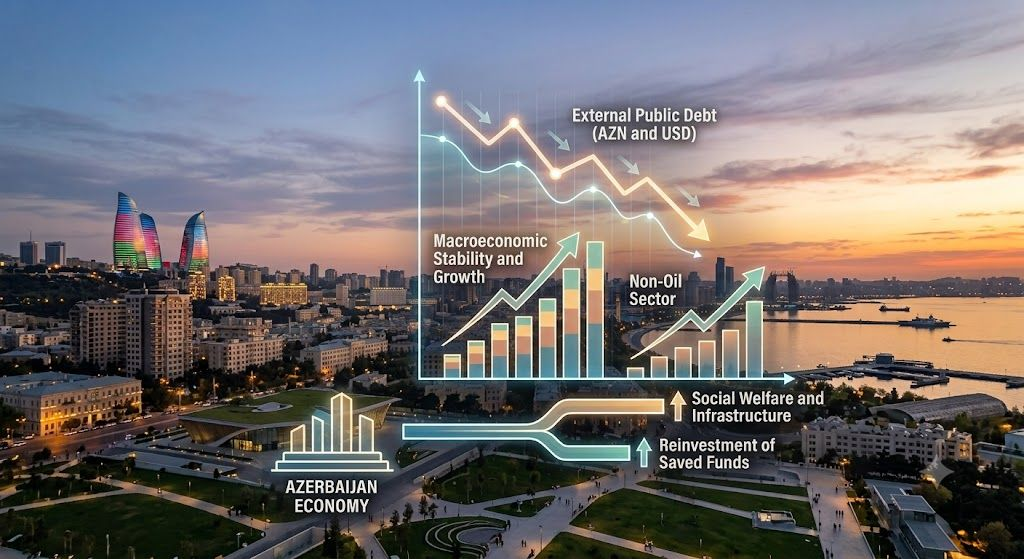
Azerbaijan’s external debt position offers a compelling example of how fiscal discipline and accumulated financial reserves can strengthen a country’s economic independence. Thus, currently, Azerbaijan ranks among the world’s top three countries with the lowest external debt relative to gross domestic product (GDP), while holding the leading position in Europe. With the ratio slightly above 5%, Azerbaijan occupies a distinctive position in the international financial landscape.
This achievement deserves recognition as a strategic economic advantage, particularly at a time when governments worldwide face rising financing costs and mounting fiscal pressures. The country’s financial indicators reinforce this position. As of September 30, 2026, Azerbaijan’s external public debt stood at $4.509 billion, while strategic foreign exchange reserves reached $89.381 billion.
Reserves were therefore approximately 19.8 times the size of external public debt. The debt figure had declined by 7.8% year-on-year, while strategic reserves had increased by 9.7%. These figures demonstrate the scale of Azerbaijan’s financial buffer and the importance of preserving it through prudent economic management.
The significance of this position extends beyond international rankings. Countries with substantial external obligations must allocate resources to interest payments and debt servicing, leaving less room for infrastructure development, social programmes and economic transformation. Azerbaijan’s relatively low external public debt provides greater flexibility in managing international shocks, responding to changing energy prices and financing strategic priorities.
Financial independence creates policy choices, and those choices become especially valuable when global markets experience volatility. Azerbaijan’s strategic reserves provide an additional layer of protection. The $89.381 billion reserve position offers substantial capacity to support external stability and meet international financial commitments.
Combined with comparatively low external public debt, these resources strengthen the country’s ability to withstand periods of weaker export earnings or tighter global credit conditions. The challenge is to maintain this advantage while ensuring that public spending generates measurable economic value. The next priority should be converting financial strength into broader productive capacity.
Extract — continue reading at the source.