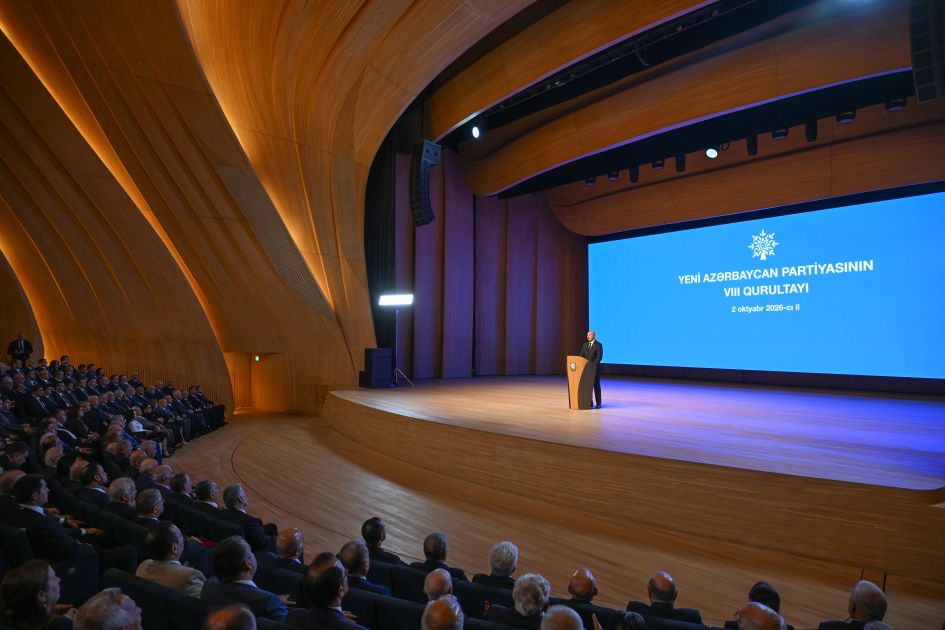
From the point of view of Azerbaijan's political elite, not all borders that are potentially dangerous are those which appear on the map. In the era of modern technology, such borders can pass right through screens, media channels, universities and various alternative narratives through which a particular society understands its history. This was one of the key conclusions that could be made from the speech of President Ilham Aliyev at the eighth congress of the New Azerbaijan Party (YAP).
But even this paragraph understates the hour-long congress. The congress was the first held since Azerbaijan restored its occupied territories. The question before Azerbaijan was no longer how the state might eventually recover what it had lost, but what kind of state should emerge after that objective had been achieved.
In President Aliyev’s case, this means that he drew a clear line back to the political groundwork laid down over three decades ago. In his view, both the triumphs of 2020 and 2023 were not merely military victories but rather culminations of a much larger process of state formation which had been started when Azerbaijan itself was politically and economically vulnerable. That historical argument matters because it leads directly into the doctrine Aliyev set out for the period ahead.
Whereas the first challenge in gaining independence was the formation of a state and the second one, restoration of its territorial integrity, the challenge posed in Baku now is the preservation of sovereignty in an entirely different sphere. Borders may be secured by means of armed forces and modern technologies. The information space cannot be protected.
It was here that Aliyev shifted from the history of victory to what he described as one of the central vulnerabilities of the modern state: ideological security. This argument goes all the way back to the turbulence of the early days of independence. Azerbaijan began the 1990s in a climate of war, political upheavals, institutional weakness, and struggle over where the new country would be going.
Within the story of politics, this was also an era when different outside forces found sympathetic networks within society, media, and the world of ideas. The counter-response represented by Heydar Aliyev was not just bureaucratic reorganization, rather, it was the formation of a political ideology: Azerbaijanism, designed to elevate the values of statehood, national unity, and autonomy from foreign ideological commitments. That sentence is perhaps the most concise description of the continuity the government wants to project.
Extract — continue reading at the source.