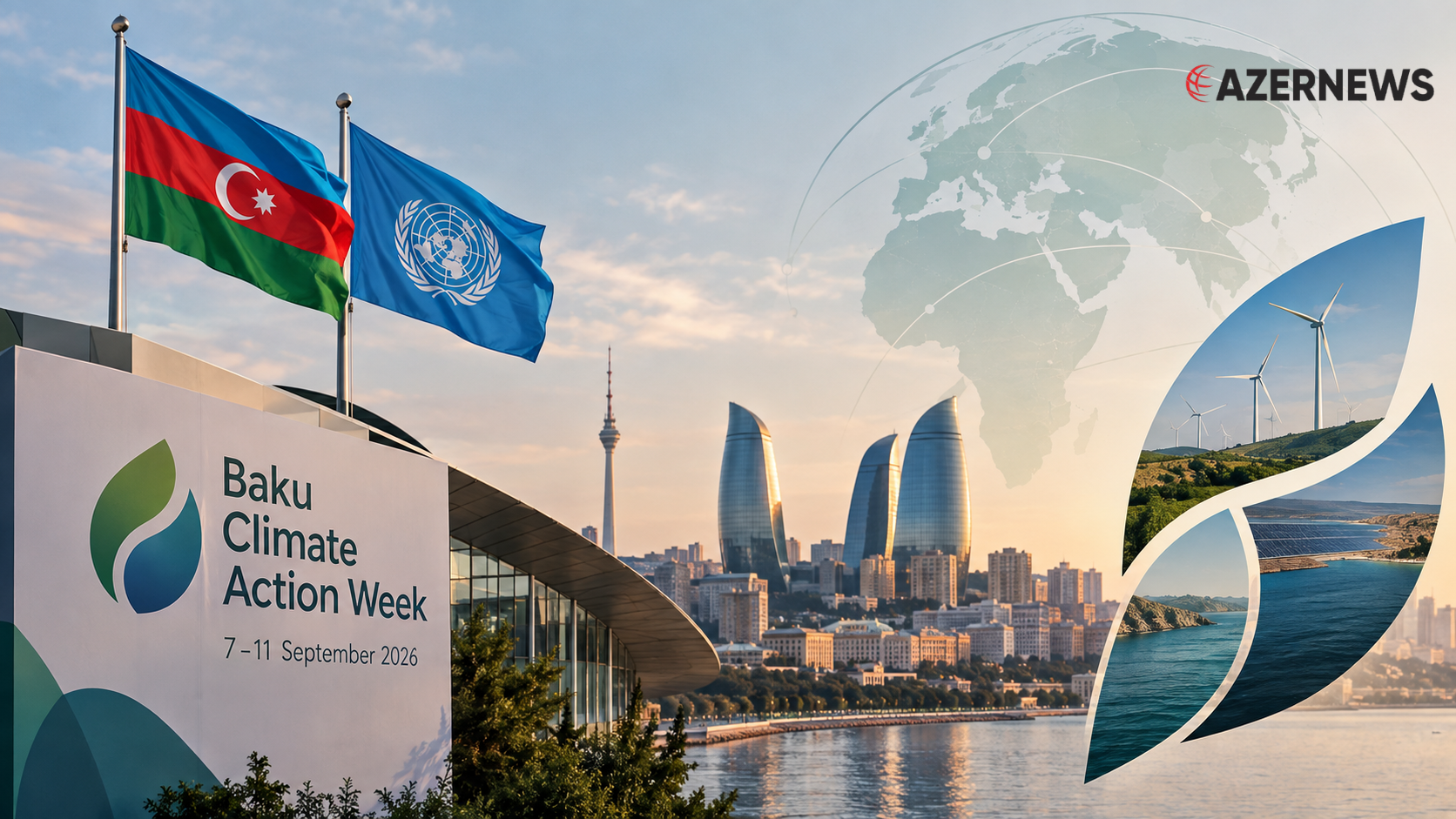
The Baku Climate Action Week makes a comeback on the Caspian Sea's coastline on September 7 with a five-day program centered on a principle that remains elusive at the annual United Nations climate conferences: continuity. The Baku Climate Action Week will be held for the third time ever, with this edition carrying more weight as an institution than any before. For the first time, the Baku Climate Action Week coincides with the Regional Climate Week of the United Nations Framework Convention on Climate Change.
This is a lineage that is worth tracing, in the sense that it reflects a format that is still being found rather than stagnating. The Climate Action Week format was developed in London in 2019, prior to COP26, as an attempt at sustaining the momentum beyond the diplomatic formality of the annual COPs. Baku introduced this concept in 2024 by holding its first edition prior to COP29, and held a second edition in 2025 when Brazil hosted COP30.
The current edition of the event is explicitly positioned as a transition to a third summit, which will take place in Türkiye for COP31, and the organisers are selling the format as a means of building continuity between presidencies rather than having each new host build from the ground up. The opening day gives a good sense of where the practical work is meant to happen. Oil major bp and Azerbaijan's state producer SOCAR sit alongside the Baku Stock Exchange and the Asian Development Bank to discuss methane abatement, carbon market integrity and cross-border renewable energy certificates spanning the South Caucasus, the Black Sea basin and Central Asia.
Getting the region’s biggest energy companies on the same stage as its financial system is the exact location from which any form of REC system or methane reduction system will need to be worked out, as these are the institutions that will end up backing and running the system. The second day will focus on artificial intelligence, including machine learning models for weather predictions for early warning systems for multi-hazards as well as a scoring method for climate-resilient agriculture backed by FAO. This is perhaps one of the more pragmatic strings of the week.
Early warning systems that use technology like GraphCast and FourCastNet already have proven track records of extending lead time forecasting, which directly makes a difference in a region that does not yet have proper infrastructure for flood and heatwave monitoring. Combining this with data-driven scoring for farmers is the kind of unglamorous work that quietly makes a difference. The most consequential item on the agenda, though, may be the one that generates the least immediate coverage: the Caspian Sea itself.
In terms of surface area, it is the largest lake on earth, but now it has reached a minimum volume that it has had in about four hundred years, with recorded decreases ranging from 9cm to 35cm each year and a net loss of coastline amounting to more than 34,000 square kilometres in the past twenty years. Estimates say that an additional decrease by up to five to ten meters in the course of this century will render the habitat for the Caspian seal and sturgeon unviable and eliminate a majority of existing marine protected areas. Coordinating between the five littoral states, including Russia and Iran, has proven to be challenging ever since the signing of the Aktau Convention of 2018 defining the legal baseline of the Caspian; precisely because of that, it is logical and long overdue that this topic is given its own discussion platform, where government representatives and scientific institutions from the entire watershed can gather together.
Extract — continue reading at the source.