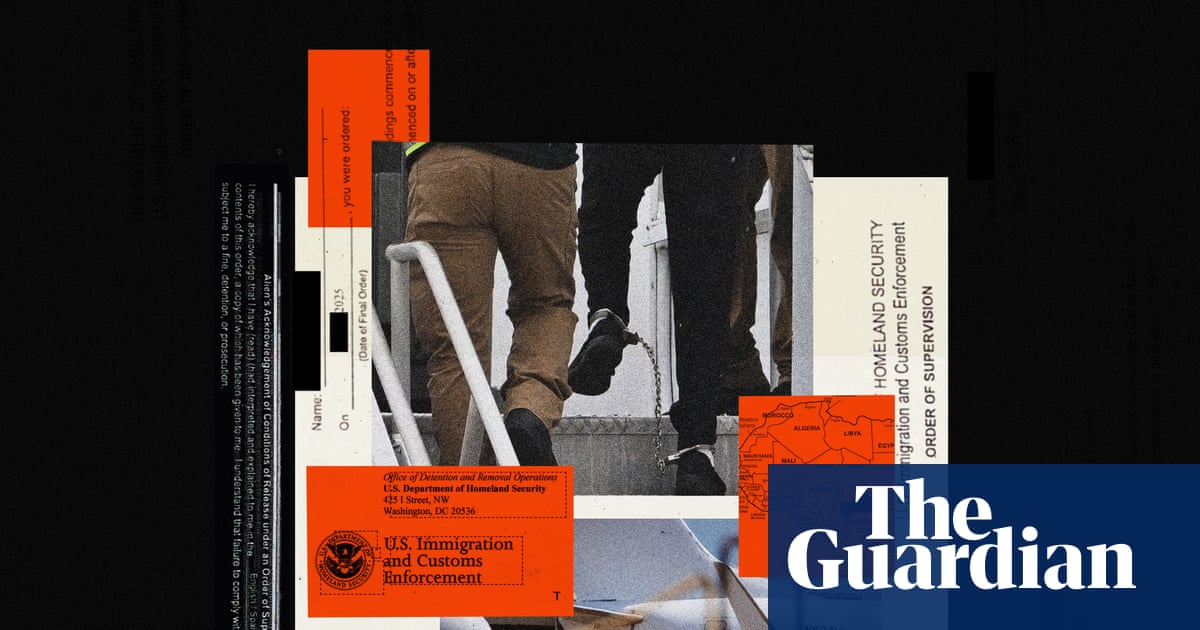
No one would tell the shackled detainees onboard the US immigration plane where they were going. The officers in charge would taunt them when they asked, they said. It was only when the seat-back video screens finally showed a map that the 18 migrants worked it out.
Their destination was Central African Republic (CAR), a country few of them had even heard of. Nika, a 32-year-old Iranian woman, recalled how the handcuffs dug into her wrists. She begged the officers to loosen them, but they did not.
Other passengers had it worse, she said. Some of the men were restrained in black and yellow body wraps, as if mummified, after resisting orders to get on the plane. Nika, who had fled Iran 18 months earlier after protesting against its regime, had imagined the US as a place of sanctuary.
Iran was already one of the most repressive countries in the world when she left, and its horrors had only deepened since then: security forces gunned down thousands of other demonstrators this year, then Donald Trump’s administration launched the war there. After more than a year locked up in a US immigration detention centre, Nika, whose name the Guardian has changed to protect her family in Iran, was granted legal protections and freed on a judge’s orders. Within two weeks, the Department of Homeland Security had rearrested her, and days later she was on the plane heading 7,000 miles east.
Nika spends most of her days there under a form of self-imprisonment, too scared to venture out from her small bedroom as she waits for an answer to the question on which her life depends: will she be sent back to Iran, and to a regime that could kill her? Nika is one of more than 25,000 people deported by the Trump administration to countries that are not their own. About 20,000 people have been bussed to Mexico, according to a count by Refugees International and Human Rights First.
And more than 5,000 others have been put on flights to countries in Africa, Latin America, the Caribbean and central Asia to which they have no connection, and then, often, returned to the countries where US immigration judges had ruled their lives or liberty were at risk. Human rights lawyers describe these so-called third-country national arrangements as part of a “show of force” by the US intended to discourage migrants and asylum seekers from entering. People from Peru and Colombia have been sent to the Democratic Republic of the Congo (DRC).
Extract — continue reading at the source.