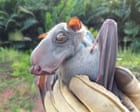
In the northern forests of the Congo-Brazzaville, as the sun slips away, a distinctive honking fills the dusky sky. Every evening, thousands of hammer-headed fruit bats depart their daytime roosts in search of mates, calling out through large, box-shaped snouts that give the flying mammals the appearance of a winged moose. Here, along the Congo River, scientists have been collecting DNA swabs and tissue samples from the bats for years, working deep into the night in spacesuit-like protective gear.
Those hard-won samples are now among the thousands of specimens gathered from bats across the world that have helped to reshape what we know about the bat family tree. In a landmark study published today in the journal Nature, a team of more than 130 international researchers combed through ancient bat fossils and genomic data from living species to establish that bats likely originated in Europe about 65m years ago – not in Africa, Asia or North America, as had previously been thought. Rather, it seems that the earliest descendants of modern bats dispersed from Europe into Africa, then expanded onwards to Asia, the Americas and Australia.
The findings also reveal that echolocation, like flight, also evolved near the dawn of bat evolution. Genomes are an organism’s complete set of genetic constructions, containing all the DNA needed to build, grow and live. The Nature study ultimately drew on 103 bat genomes from 21 bat families, alongside 44 fossil bats – mostly their teeth – unearthed across the globe.
Olson said their findings lay the groundwork for better understanding bat physiology and, critically, how the mammals have evolved to be so resistant to disease. Bats are often identified as reservoirs of fatal zoonotic viruses, including Ebola, Nipah and Marburg – but the bats don’t get sick themselves. Bats are also unique among mammals in that they live exceptionally long for their size, showing few signs of ageing or cancers.
Now, scientists say they will be able to investigate the genes driving those traits. What they learn could be a gamechanger for research into human ageing, immunity and disease resistance. And they could also be models to develop treatments for cancer,” Morales said.
Olson added that the research can also strengthen our understanding of “what makes a healthy bat a healthy bat, and what are bats going to be susceptible to?” About half of the known bat species have unknown or decreasing populations, with 18% of species considered threatened by the International Union for the Conservation of Nature. Bats are at risk from the climate crisis, habitat loss, and bat persecution and harvesting, said study co-author Liliana Dávalos, a conservation biologist at Stony Brook University in New York. At the same time, bats play an important role in ecosystems, helping to pollinate plants, spread seeds, and keeping insect numbers – particularly mosquitoes, another spreader of disease – in check.
Extract — continue reading at the source.