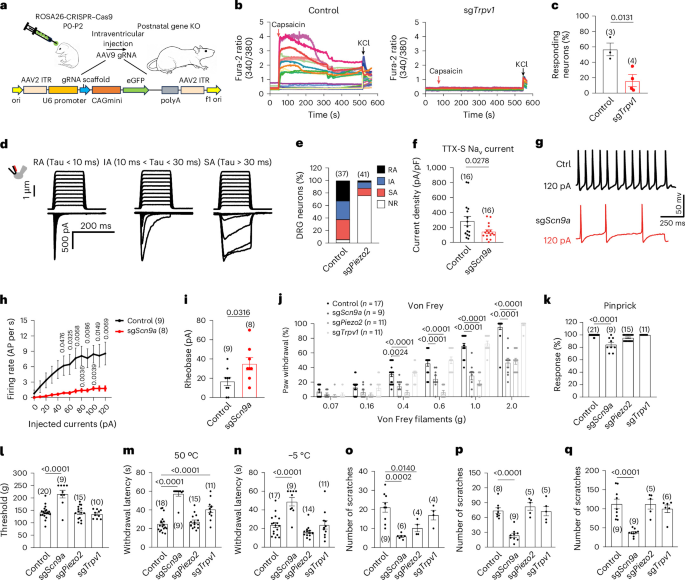
Somatosensation is mediated by dorsal root ganglion (DRG) neurons, which convert physical and chemical stimuli into electrical signals. However, the full repertoire of molecular components underlying somatosensation remains incompletely identified. Here we developed an efficient postnatal CRISPR–Cas9 knockout platform for interrogating DRG-expressed genes (such as Piezo2, Trpv1 and Scn9a) in mice using AAV9-mediated single-guide RNA delivery.
Combining this approach with somatosensory behavioral assays, we performed a targeted screen of 20 genes and identified Creld1 as a cross-model regulator of somatosensation. Either single-guide RNA-mediated postnatal knockout or tamoxifen-induced Cre-mediated deletion of Creld1 in DRG neurons resulted in profound behavioral deficits in touch, temperature, pain and itch, whereas its overexpression enhanced touch and thermal responses. Mechanistically, CRELD1 functions as an auxiliary regulator of voltage-gated sodium channels (Nav) for controlling DRG neuron excitability.
Together, this work establishes a robust postnatal screening platform for behavioral genomics and identifies Creld1 as a master regulator of somatosensory function. This is a preview of subscription content, access via your institution Access Nature and 54 other Nature Portfolio journals Get Nature+, our best-value online-access subscription Receive 12 print issues and online access Prices may be subject to local taxes which are calculated during checkout Source data are provided with this paper. Sensory neuron sodium channels as pain targets; from cocaine to Journavx (VX-548, suzetrigine).
Physiol. 157, e202513778 https://doi.org/10.1085/jgp.202513778 (2025). Meltzer, S., Santiago, C., Sharma, N. & Ginty, D. The cellular and molecular basis of somatosensory neuron development.
Neuron 109, 3736–3757 (2021). Article CAS PubMed PubMed Central Google Scholar Caterina, M. The capsaicin receptor: a heat-activated ion channel in the pain pathway.
Nature 389, 816–824 (1997). Identification of a cold receptor reveals a general role for TRP channels in thermosensation. Nature 416, 52–58 (2002).
Extract — continue reading at the source.


