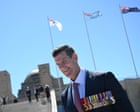
Anthony Albanese has honoured Australian troops who served in Afghanistan, using the 25th anniversary of the country’s involvement in the conflict to describe their heroism as a fight for “who we are as a people”. The prime minister joined hundreds of veterans, family members and dignitaries at a commemoration of the start of the campaign in Canberra on Sunday, with nation’s most decorated living soldier and accused war criminal Ben Roberts-Smith among the crowd at the Australian War Memorial. The world felt upended,” Albanese said of the start of Operation Slipper.
We went to support our friend and ally. Roberts-Smith, who denies the allegations against him, attended the event alongside family members and supporters, as well as former prime ministers John Howard, Tony Abbott and Scott Morrison. The governor general, Sam Mostyn, and the opposition leader, Angus Taylor, were also present in the bright sunshine.
Roberts-Smith was awarded Australia’s highest military honour – the Victoria Cross – for his service in Afghanistan, but now faces accusations he murdered five unarmed detainees during his deployment. The former Special Air Service regiment corporal sat alongside his partner, Sarah Matulin, after a judge agreed to vary his bail conditions to allow him to visit Canberra. Deployments to the Middle East continued until withdrawal from Afghanistan in 2021.
US troops left a few months later after signing an agreement with the Taliban, who swiftly returned to power and reintroduced authoritarian control, including strict suppression of women and girls’ rights. Some 47 Australian personnel died as a result of their service and 263 were wounded, while thousands more allied soldiers were killed. Tens of thousands of civilians were also estimated to have been killed during the war.
Despite the controversy over Australia’s military involvement in Afghanistan and its legacy, the troops who served on the ground remain intensely proud of what they achieved. Soldier Mathew Bell was deployed in 2012, aged 24, with his infantry battalion to a forward operating base in Afghanistan’s “badlands” west of Tarinkot. More than a decade after he returned to Australia, Bell remembers his unit’s work with a sense of honour and accomplishment.
Bell said girls were able to attend school, medical services were rolled out to villages and “there was freedom”. Once you stepped over that line in the sand, like, that was Taliban territory.” One of Bell’s close mates was badly wounded in a roadside bomb explosion and on more than one occasion, his section was pinned down by sniper fire. Services were also held at the Anzac Memorial in Sydney’s Hyde Park, at Melbourne’s Shrine of Remembrance and other sites around the country.
Extract — continue reading at the source.