The icon indicates free access to the linked research on JSTOR. Talk-talk, said Winston Churchill (reputedly), is always better than war-war. But how is such diplomatic talk-talk recorded for posterity?
Until relatively recently, history has depended mostly on written records. Those are never the same as conversations, which by their very nature are ephemeral. The recollection, reconstruction, and/or condensing, in the “minutes” of a meeting, of what was said is the issue sociologist David R.
Converting “talk with all its complexities, disfluencies, ambiguities, and occasional disarray, into a written record of who said what,” writes Gibson, is no easy task. Every historian should be aware of the potential pitfalls of this fraught form of translation. With so much of the news reliant on anonymous sources, the issues raised are important for a functioning democracy as well.
Meeting minutes, writes Gibson, are “traces of words uttered behind closed doors, but they often have the appearance of a verbatim report, and even when they do not, it is tempting to read them that way, lulling us into erroneous conclusions about who said what, how they said it, and whom they were in agreement with.” Such minutes in the official compendium of “major U.S. foreign policy decisions and significant diplomatic activity” that is the State Department’s _Foreign Relations of the United States_ (_FRUS_) series are given the imprimatur of history. But what exactly are they? (_FRUS_ holdings begin with the Lincoln administration and are amply voluminous; there are, for instance, 25 volumes for the Kennedy administration and a planned 48 volumes for the Clinton administration.) Minutes may be edited after the fact, by “the minute-taker or someone else,” notes Gibson. Members of the Soviet Union’s Politburo were neither the first nor the last who could and would alter minutes before they were disseminated.
Gibson continues that “we might say that minutes are not merely _taken_, but actively _made_, and the minute-_takers_ are equally minute-_makers_, sometimes with input from others.” “Memories of talk” in after-the-fact minutes are as suspect as any other memories. Another problem is spin.” Theodore Roosevelt was the first White House occupant to seek control over how newspapers covered him. Spin, like gravity, seems to be a given.
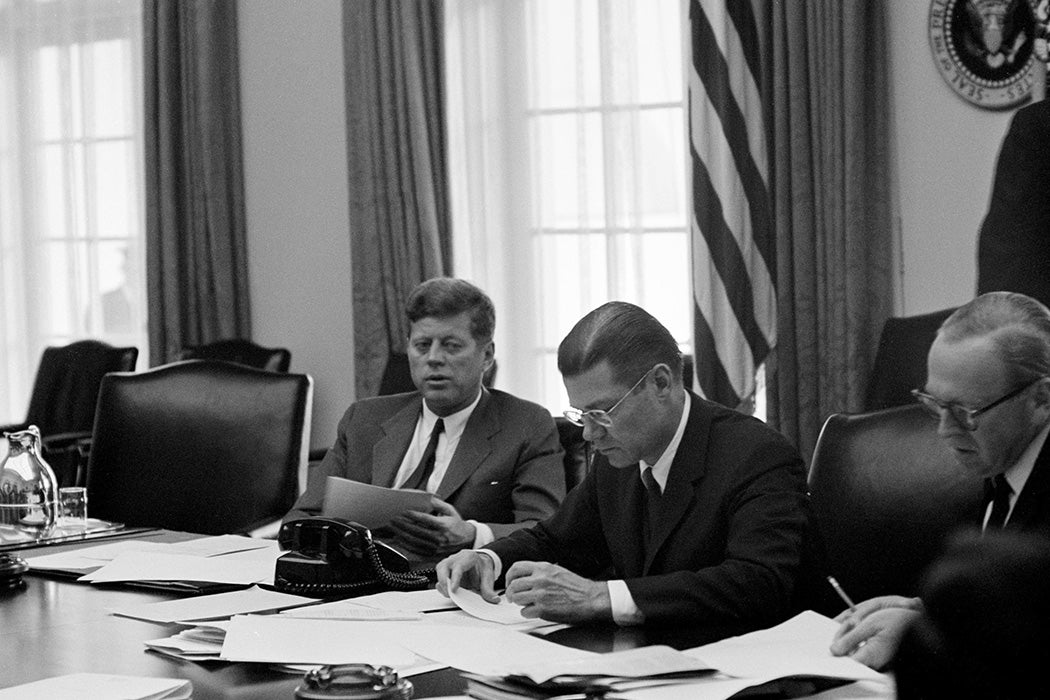
Gibson gives the example of Attorney General Robert F. Kennedy, who “exaggerated his importance as an advocate for the temperate approach that brought the crisis to a peaceful resolution” during the heady days of the Cuban Missile Crisis in October 1962. The reason we know this is that Kennedy’s brother, President John F.
Extract — continue reading at the source.