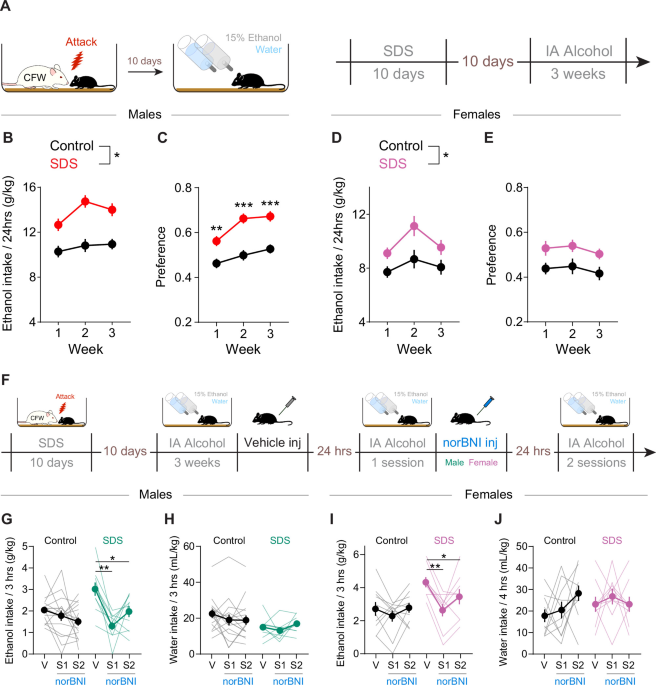
Aversive social experiences can increase alcohol consumption and precipitate relapse during abstinence. Individuals who drink to alleviate social stress are at a heightened risk for developing an alcohol use disorder (AUD). In rodents, repeated social defeat stress (SDS) enhances motivation to consume alcohol, yet the underlying neural mechanisms remain poorly understood.
Here, we investigated the role of dynorphin/kappa opioid receptor (Dyn/KOR) signaling in regulating stress-induced increases in alcohol consumption. We show that repeated SDS increased alcohol intake and preference in both sexes, effects that were attenuated by systemic administration of the KOR antagonist norBNI or local administration of norBNI into the bed nucleus of the stria terminalis (BNST). Chemogenetic activation of basolateral amygdala (BLA) KOR-expressing neurons and their projections to the BNST, as well as knockdown of KORs in the BLA, attenuated increased alcohol consumption following SDS.
At the molecular level, SDS increased Pdyn mRNA expression and selectively activated BNST-projecting dynorphin neurons in the dorsal raphe nucleus. Together, these findings support a working model where Dyn/KOR modulation of the BLA–BNST pathway is critical for increased alcohol drinking induced by social stress, while pointing to the DRN as a candidate upstream source of Dyn. Our results highlight Dyn/KOR systems as a promising therapeutic target for comorbid stress-related pathology and AUD.
Social stress is highly prevalent in humans and can precipitate a wide variety of neuropsychiatric conditions including mood and substance use disorders [1,2,3]. Exposure to repeated social stress is associated with increased drug intake and increased risk of relapse to drug seeking for a variety of drugs including cocaine and alcohol [4, 5]. The link between social stress and alcohol misuse is well established.
Individuals who consume alcohol to alleviate social anxiety and stress are more likely to meet the Diagnostic and Statistical Manual (DSM-V) criteria for an alcohol use disorder (AUD) [6]. Further, exposure to moderate or severe psychosocial stressors is associated with increased likelihood of developing a sustained pattern of uncontrollable drinking in those who drink as a coping mechanism [6,7,8,9]. The effects of social stress in humans can be evaluated with the Trier social stress task (TSST), which results in increased craving and responding to alcohol in patients with AUD, suggesting that these individuals are more likely to misuse alcohol to cope with negative social situations [10,11,12].
The high comorbidity between stress and AUD [13,14,15,16,17] underscores the importance of studying molecular mechanisms underlying the effects of stress on alcohol use. There are several types of psychosocial stressors including social exclusion, social defeat stress, and social isolation stress [5]. Social defeat stress (SDS) is modeled in rodents using resident-intruder procedures where test mice are subjected to attacks by an aggressive mouse strain [4, 18, 19].
Extract — continue reading at the source.


