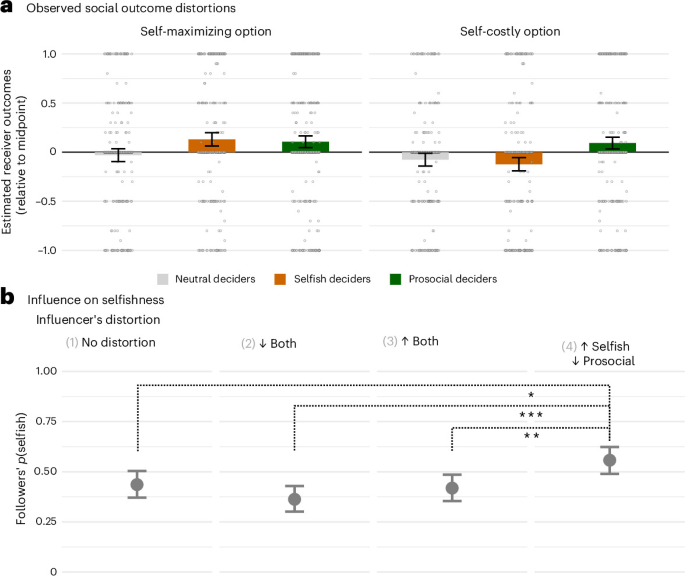
From consumers buying fair-trade products to policy makers funding science, people often do not know exactly how their actions will affect others. We show that selfish and prosocial actors alike may distort their impact in self-serving ways, but selfish-serving distortions catch on more readily than prosocial-serving distortions and increase followers’ selfishness. This is a preview of subscription content, access via your institution Access Nature and 54 other Nature Portfolio journals Get Nature+, our best-value online-access subscription Receive 12 digital issues and online access to articles Prices may be subject to local taxes which are calculated during checkout Fehr, E. & Charness, G.
Social preferences: fundamental characteristics and economic consequences. This review discusses how people differ in weighing outcomes for others versus outcomes for themselves. Exploiting moral wiggle room: experiments demonstrating an illusory preference for fairness.
This article introduces a paradigm that shows that people use ignorance of social consequences to act selfishly. Reher, K., Götz, M., Toscano, F. & Gross, J. Does ignorance love company?
The social dynamics of information avoidance. Psychol. 125, 104917 (2026). This article shows that both the social acceptance of ignoring social consequences and the choice to do so change depending on how widespread ignorance is.
A., Oud, B., Fehr, E. & Crockett, M. Motivated misremembering of selfish decisions. This article shows that people misremember their decisions as more generous than they actually were.
Article CAS PubMed PubMed Central Google Scholar Haisley, E. Self-serving interpretations of ambiguity in other-regarding behavior. Behav. 68, 614–625 (2010).
Extract — continue reading at the source.


