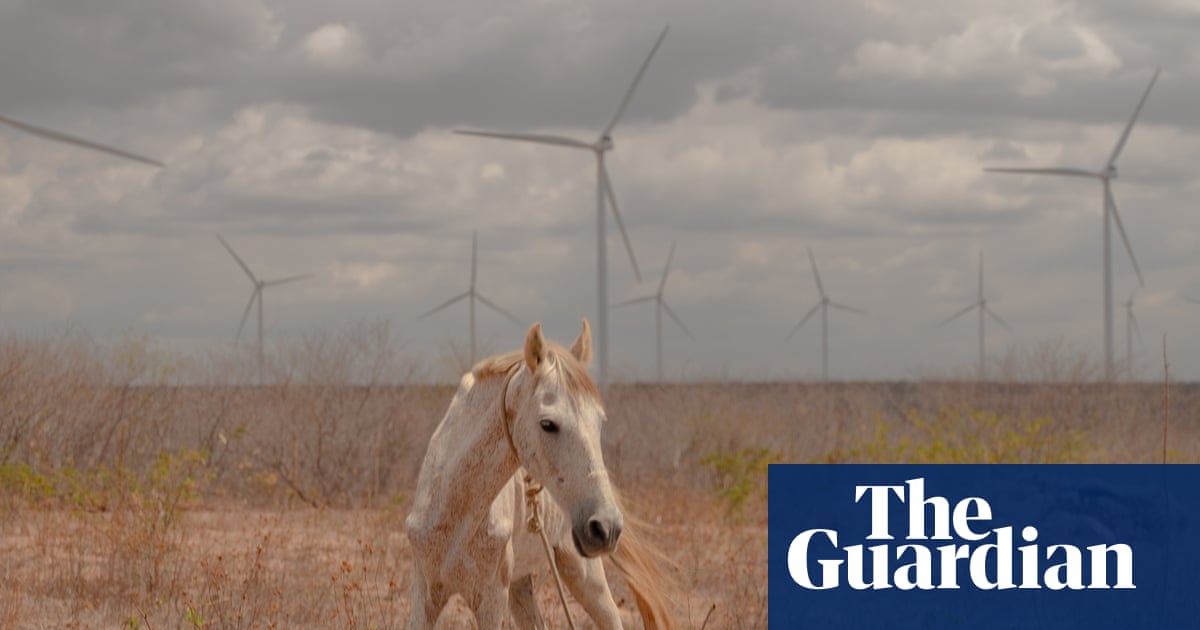
Beneath the power lines cutting across Antonio de Souza’s property in Serra do Mel, in north-east Brazil’s Rio Grande do Norte state, rows of cashew trees once stood – until the clean energy company ordered them to be cut down. De Souza cannot plant crops in the affected area and the tractor cannot be driven through it in bad weather, as the driver risks an electric shock. Cattle, another source of local income, are forbidden from grazing near the cables.
The contract says the infrastructure occupies one hectare (2.5 acres); yet, the farmer counters, four hectares have become wasteland on a 50-hectare plot that was the family’s livelihood. The story of Serra do Mel is one often heard in places where wind has provided energy and development, a model now moving offshore. But still rarely discussed is how the benefits can also harm local communities’ health and livelihoods.
Brazil has about 35GW of onshore wind capacity in commercial operation, the fifth largest in the world, according to the Brazilian Association of Wind Energy and New Technologies (ABEEólica) and the Global Wind Energy Council. In November 2023, in Riyadh, Brazil’s president, Luiz Inácio Lula da Silva, summed up the nation’s ambition: within 10 years, Brazil would be known as the “Saudi Arabia of green energy”. Nine in 10 of Brazil’s wind turbines are in the north-east, thanks to the constantly strong winds, which engineers often describe as the “best in the world”.
It is also among the regions with Brazil’s worst social indicators. This convergence could have resulted in a historic redistribution of wealth, but those in the turbines’ shadow tell a different story. When representatives of the French renewable energy multinational Voltalia arrived in his village after a year of drought, De Souza signed the contract, as did almost everyone in the area.
The promise was a monthly income of 3,000 to 5,000 reais (£430-£720), adjusted annually like a salary, without harming crops. A decade later, the farmer is leading a public civil lawsuit against Voltalia, filed in May 2025 by three rural workers’ organisations, with a favourable assessment from the public prosecutor’s office and the public defender’s office, which provides legal aid, monitors human rights and has an ombudsman role. The people of Serra do Mel are not calling for the company to leave but they do want to know how much the energy generated on their land yields and to receive what they say was promised to them.
They also want to regain the right to retire as farmers, which is at risk because they can no longer work their holdings – land the Brazilian state granted to needy farmers 50 years ago is now leased to a multinational for another 50. The payments, hard to audit, are 1.55% of turnover, which will depend on where the energy is sold. Data from the National Electricity Agency (Aneel), compiled by the Lavoro Institute, shows that 17 of the Serra do Mel power stations sell all of their electricity on the open market.
Extract — continue reading at the source.