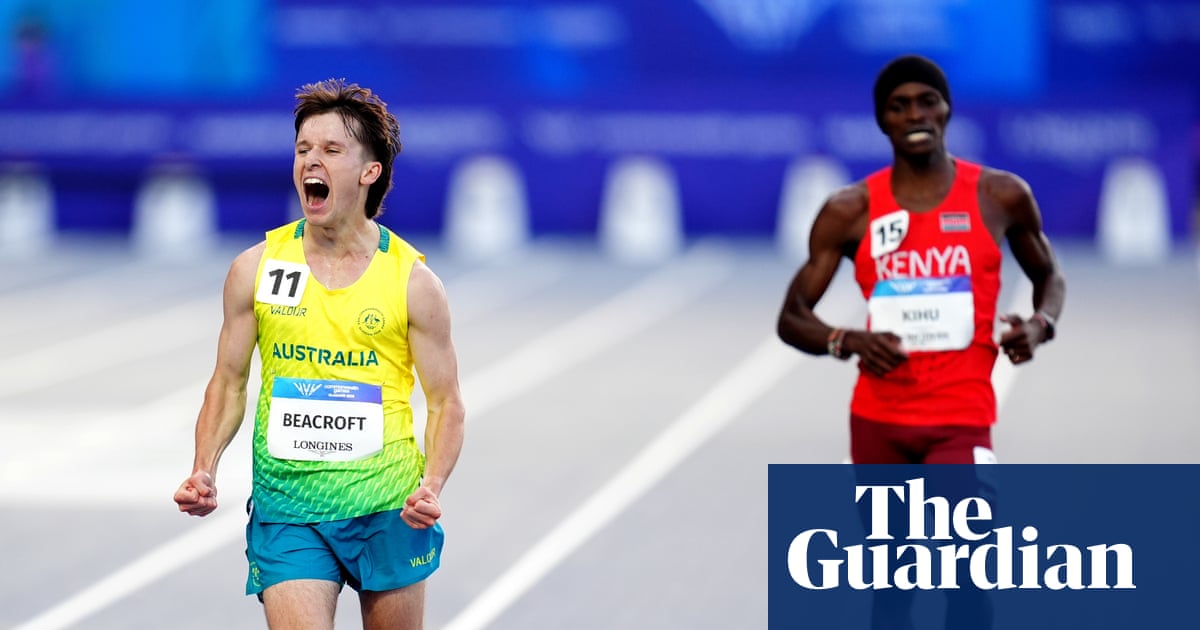
Australia’s teenage race walker Isaac Beacroft won gold at the Commonwealth Games this year, propelling him into contention for a medal at the home Brisbane Olympics in six years’ time. There is just one problem. The International Olympic Committee is considering culling events like his – as well as surfing, skateboarding and climbing, in which Australia also has strong podium chances – in secretive deliberations under way in Switzerland that are set to transform the Olympic program.
Officials within sports are not watching idly while their fates are determined in Lausanne, however. Modern pentathlon has ditched its horse riding component for a ninja obstacle course. Canoe sprint is moving away from longer distances to focus on the more dramatic, explosive 500m events.
Some in race walking, like Beacroft, have their own plan: a microchip in competitors’ shoes. The 19-year-old, who won gold in Glasgow thanks to a final-lap surge, says the chip – alongside shifting the event distance from 20,000 metres to the more broadly relatable half marathon – is “the race walkers’ play to keep it in the Olympics”. The chip “detects the flight time” of walkers, Beacroft explains, thereby eliminating the subjectivity from judging.
A planned reduction in the number of sports for Brisbane, a decreased cap of 10,500 athletes, and a need for the Olympics to modernise leaves emerging sports competing with traditional pursuits such as fencing and wrestling. The IOC is also assessing each “discipline” – seeing, for example, track and road cycling as separate – based on its television audience, cost and complexity of facilities, and size of athlete cohort. The traditional heavyweights are swimming, gymnastics and athletics, the latter with 1,810 competitors at LA 2028 or close to one-fifth of the entire athlete body.
Each will retain their place, though some events or disciplines such as race walking may be vulnerable. Meanwhile, sports with bespoke venues like triathlon, or large athlete quotas like rowing and hockey, will be looked at closely in a process dubbed as “fit for future” by the IOC. As IOC officials enter their final months of decision-making, several of Australia’s potential podium contenders for 2032 including Beacroft, skateboarders Arisa Trew and Chloe Covell, climber Oceana Mackenzie (currently ranked second in the world in bouldering) and surfers like world No 1 Molly Picklum are in jeopardy of missing out if the IOC leaves their disciplines out of the core program.
Their participation would then require the Brisbane organising committee to include these sports as one of the hosts’ additional picks, limited to four, akin to how breaking was included in Paris. Competition for those places is set to be fierce as Australian favourites like netball, surf lifesaving and touch football join the frenzy of aspirants vying for an Olympic berth. There is another consideration, however, that has officials sweating.
Extract — continue reading at the source.