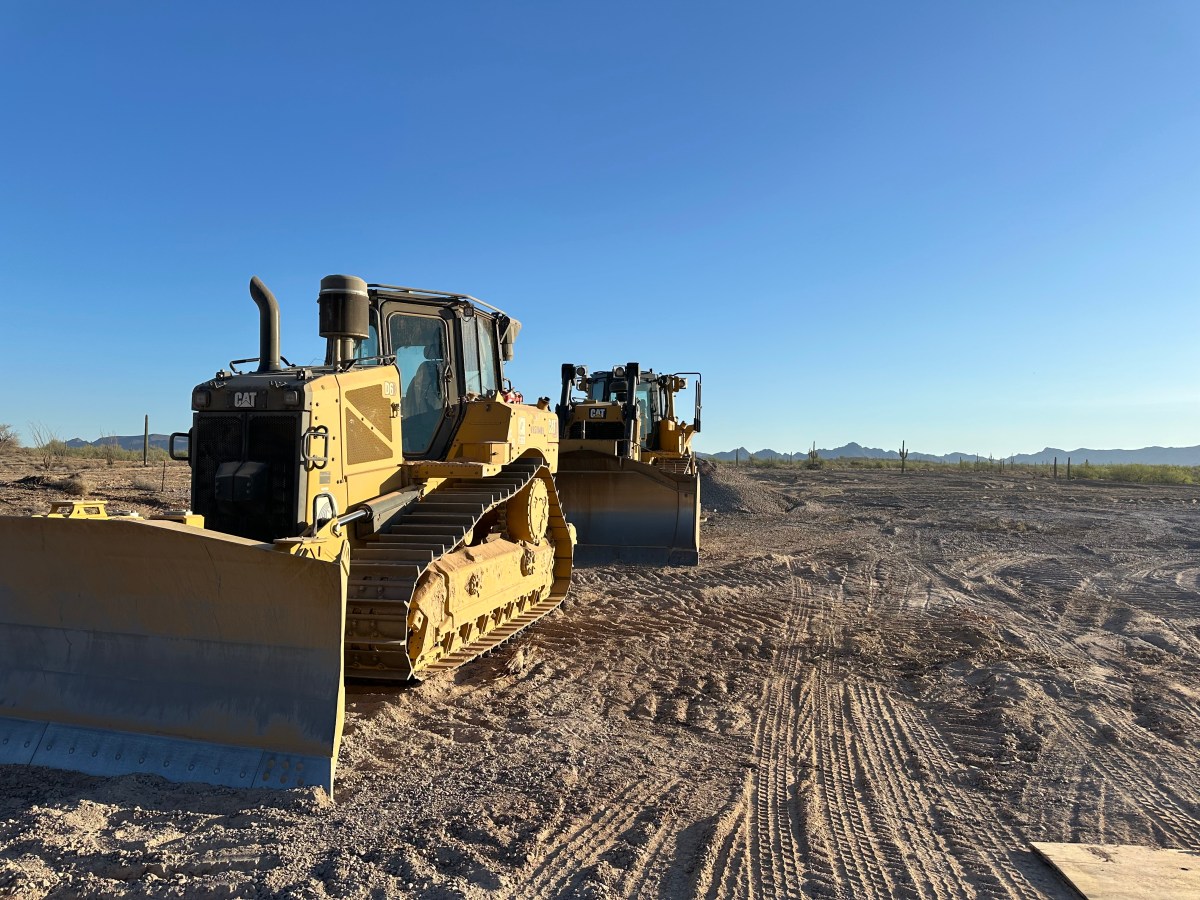
Bulldozers are clearing protected desert habitat in Arizona’s Organ Pipe Cactus National Monument as construction begins on a second wall along a stretch of the U.S.-Mexico border already lined by a 30-foot barrier. The work is part of President Donald Trump's administration’s expansion of border infrastructure across the Southwest that U.S. Customs and Border Protection (CBP) describes as a “Smart Wall” system combining primary and secondary steel barriers with patrol roads, cameras, lighting and other detection technology.
CBP said 381.2 miles of secondary border wall are under construction nationwide. At Organ Pipe, federal contractors have begun clearing Sonoran Desert habitat for the additional barrier, according to the National Parks Conservation Association (NPCA), which published images of the construction on Wednesday. The group said the existing 30-foot wall, built beginning in 2019, already extends across the monument’s entire southern boundary with Mexico.
The construction follows plans announced by CBP to build or maintain roughly 222 miles of border barrier systems in Arizona’s Tucson Sector, including about 42 miles of secondary barrier. The Department of Homeland Security (DHS) waived a series of legal requirements in November 2025 to expedite border construction in the state, according to CBP. Conservationists said the latest construction risks further damage to an ecologically sensitive landscape and to sites of cultural importance to Indigenous communities, including Quitobaquito Springs, a desert oasis near the border.
NPCA said National Park Service road closures in the area have also complicated access to the springs. The construction comes amid a broader dispute over new border barriers on protected and tribal lands in Arizona and elsewhere along the U.S.-Mexico border, including in Texas’ Big Bend National Park, where border wall construction has also faced environmental and legal challenges. Last week, a federal judge declined to block the administration from moving ahead with plans for 62 miles of border wall along the neighboring Tohono O’odham Nation, whose leaders have warned that construction could permanently damage sacred sites and disrupt cultural ties across the border.
Newsweek contacted CBP and the NPCA via email for comment on Friday. Photos taken inside Organ Pipe Cactus National Monument on August 16 and 17 show heavy machinery, construction vehicles and large areas of desert that have been stripped of vegetation as work on the new barrier gets underway. The images were taken by Russ McSpadden, a Southwest conservation advocate with the Center for Biological Diversity, who documented two areas of clearing east of Quitobaquito Springs.
According to the organization, one is a construction staging area about 3.4 miles east of the springs, while another, roughly 2.5 miles east, is a cleared strip where the second wall is expected to be built. The Center for Biological Diversity said the new barrier is planned about 100 feet north of the existing wall, leaving a corridor between the two structures. CBP described secondary barriers more broadly as one component of its “Smart Wall” system, which can also include patrol roads, cameras, lighting and other detection technology.
Extract — continue reading at the source.