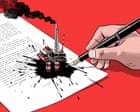
When the news broke that the UK government had approved the Jackdaw gasfield, I was at a Guardian climate event at the Royal Geographical Society. Appropriately, the theme suggested by readers was what can the public actually do in the face of what feels like paralysing climate doom? There is so much going on that is hopeful: biodiversity tracking, river protection, rewilding.
Shruti Suresh, from the independent watchdog Global Witness, told those in attendance that if they wanted to effect change, they should protest against Jackdaw and the Rosebank oilfield project. The message was so well understood that it didn’t need labouring. The mood in the room when the news came in was one of audible dismay.
People had just watched the minister for climate transition declare that she could see the challenges ahead and was ready for them. The Jackdaw announcement will face immediate protest and legal challenge, but it sends a very clear signal from the government: we don’t mean what we say about ending emissions. It turns out you can take all imaginable personal responsibility to arrest the climate crisis, make lifestyle adjustments that even five years ago you wouldn’t have dreamed of, miraculously summon the energy to take collective action from what is often private despair, but it will be insufficient as long as corporations – assisted by the government – are working against you, in effect with impunity.
At some point, you need to get the people you elected to do what we all know – and they acknowledge – is necessary. The Jackdaw decision had been quietly parked during the Holborn and St Pancras byelection, when the threat of the Greens seemed greater to Labour than it turned out to be. But while Labour successfully buried the issue during the campaign, the underlying issues surrounding Jackdaw – and Rosebank, which is yet to be decided upon – persist.
Since the 2015 Paris agreement, we have been committed to try to limit temperature rises to 1.5C, and we’ve known for at least five years that means the vast majority of fossil fuels have to stay in the ground. As of 2024, there’s been scientific consensus that the target of 1.5C is “deader than a doornail”, while this week’s emissions-gap report could not be clearer: the threshold will be breached and it will cause unimaginable damage, yet with urgent emissions reduction, there is a way back from the abyss. There is no workable argument that runs: “Everyone has to leave their fossil fuels in the ground, as a matter of the utmost urgency, except for us; everyone has to prioritise the long-term survival of a livable planet over energy bills, except for us; we all need to reach carbon neutrality and worry about high-skilled jobs later, except for us.” The Jackdaw field isn’t huge, will peak in a short time and won’t on its own reduce energy bills, which are determined by global markets.
So it’s tempting to shuffle it off as a side-order issue, but it matters: it destroys our moral authority as a nation and it extinguishes hope. The climate debate operates on two tracks that don’t meet. On the one hand, we talk about non-linear irreversible tipping points whose effects would be so seismic that the question of mitigation is too vast and, frankly, too painful to consider.
Extract — continue reading at the source.
