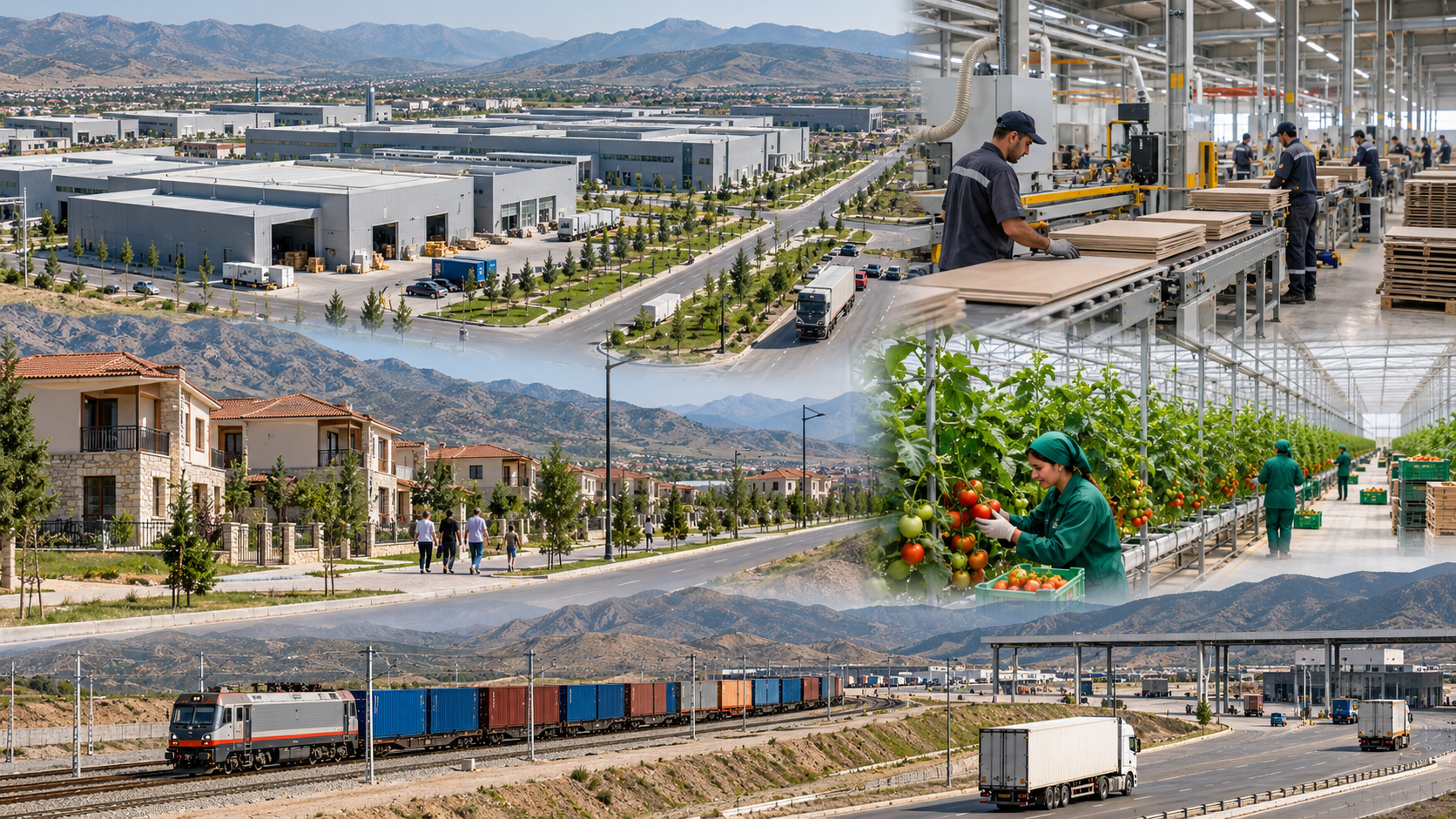
For almost six years now, the tale of Karabakh and Eastern Zangezur has been told through the prism of infrastructure: road-building, tunnels, electricity lines, house-building, and countless hectares of mined land being decontaminated. But times are changing, and the tale is evolving into a different genre. This was evident during the Rebuild Garabagh exhibition in Baku last week, when the emphasis was on industries, greenhouses, and export deals.
The evolution is intentional, and it represents the moment when the Azerbaijani government asks whether the region can pay for itself. The magnitude of the first stage is what accounts for the new ambition. As President Ilham Aliyev points out, the state has used 25.5bn manats, equivalent to around $15bn at today’s exchange rates, for reconstruction of villages and towns, restoration of transport, electricity and utilities, and clearance of around 300,000 hectares of land contaminated with mines and ordnance, using its own funds.
Some 40,000 people have already returned to 47 settlements, while 100,000 more live and work in the region. This represents quite a commitment by a nation of 10m people. Official material gives the Finance Ministry's forecast for 2027–30 as 13.2bn manats (some summaries of the medium-term framework say "over 10bn"), enough to keep reconstruction going.
But President Aliyev's message to the exhibition was that money alone will no longer set the pace. The aim of the second "Great Return" programme, he said, is "to further increase private investment, expand permanent employment and export-oriented production" and to turn the region into "a new center of economic growth for the country". The example of the test case is the Aghdam Industrial Park, the project area of which is 190 hectares and the construction of whose infrastructure started back in May 2021.
This enterprise is located close to road and railway routes, provides tax, customs, utility, and rental discounts, and operates under a “plug-and-play” principle – the infrastructure is created, investors are attracted. At the halfway point in the year, the industrial park already had more than 30 residents and another four firms that were not residents but operated there and provided around 1,230 jobs. In October, two more enterprises were approved by the economic zones agency – the flour mill and a plant for the production of oil from sunflower, corn, soybean, and cottonseed.
The list of goods is reminiscent of the catalog of the dull and unspectacular center of an industrial economy – electrical distribution equipment, panels for roofs and façades, ventilating and firefighting equipment, metal products, telemetric equipment, construction blocks, furniture, wallpapers, shoes, and cigarettes. This is not a technological cluster. This is something more practical for a country seeking to substitute its imports – light manufacturing that employs many workers and teaches supply chains to work.
Extract — continue reading at the source.