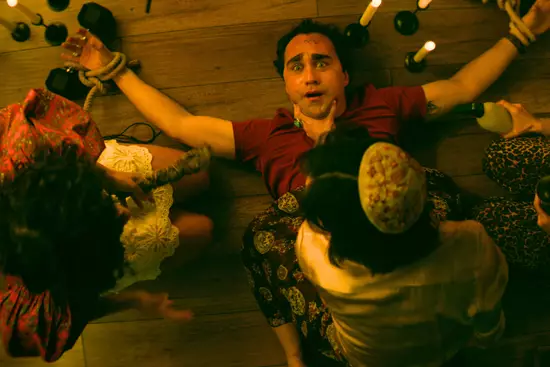
He’s set to star as a man who’s kidnapped at a Toys R Us and locked in the store’s basement. When he realizes his handcuffs are actually made of fuzz, he escapes and returns home. Back to safety, he discovers that his wife has already moved on and hooked up with his twin brother, also played by the comedian.
Weird one-and-done Netflix comedy? Thompson’s series, called “MisTaken,” is part of 100 Zeros, a new venture launched by Google and Range Media Partners to produce vertical microdramas. Thompson, along with director McG and “The Bachelor” creator Mike Fleiss, is one of the more high-profile names looking to play in the fast-growing microdrama space, where series consist of 60 or so episodes that barely last a minute each and feature minimal production values, mostly unknown stars and budgets that average $250,000.
Cliff-hangers, story arcs and emotional beats are required every few seconds to keep users engaged. Everyone is on their phone,” Douglas says of the new twist on short-form content. Before, they go through the traditional process and nothing gets made; they’re at the mercy of studios and notes and development.
With this model, we’re like, ‘Yeah, you’re not going to make any money up front, but you can go make the thing that you’ve been really passionate about.’” The endgame could be a microdrama hit or IP that turns into a franchise — which then could be used as the proof of concept to pitch a long-form TV series or film. Some creators and stars see this as a steppingstone to entering the mainstream, but inside the growing microdrama industry, the goal is simply to make habit-forming content for viewers on their phones. Is there ultimately any money to be made in the microdrama space?
Can this expanding industry give a struggling Hollywood workforce a shot in the arm? Or is this Quibi all over again? Founded by Jeffrey Katzenberg and Meg Whitman, Quibi spent more than $1 billion on high-end short-form projects from A-list producers like Guillermo del Toro, Antoine Fuqua and Sam Raimi.
But given the amount of free fare available on YouTube and TikTok, consumers weren’t looking to pay hefty subscription fees to watch a handful of premium shorts. Also, Quibi didn’t own its programming. And a worldwide pandemic didn’t help the timing.
Extract — continue reading at the source.