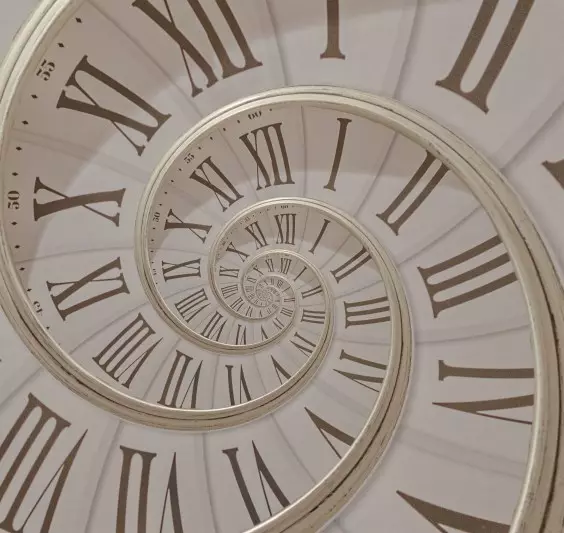
From both a philosophical and a scientific perspective, we’re taught to doubt, question, and be skeptical of everything. Even the reality of ourselves and our own experiences cannot be taken for granted, as we must make certain assumptions about how trustworthy our measurement sensors — and our own senses, for that matter — actually are in order to arrive at any satisfactory conclusions. Sure, certain things might appear real, but it’s also possible that those “real” appearances are deceiving us, and that quantities or concepts that we take for granted might be nothing more than very convincing illusions.
When we consider our physical reality, however, these sorts of questions take on a different meaning. We’ve learned lots of surprising and counterintuitive lessons from our investigations of time. Time is relative, not absolute.
Time always marches forward, never backward, but we still lack an explanation for the perceived arrow of time. Thermodynamically, the Universe has an arrow of time, which “flows” in the same direction as increasing entropy. And when we investigate the Universe on an elementary level, it turns out that time may not necessarily be fundamental at all.
But can time’s existence itself be eliminated? It’s very, very difficult to take that property away from time and to still wind up with a Universe consistent with what we observe. This snippet from a structure-formation simulation, with the expansion of the Universe scaled out, represents billions of years of gravitational growth in a dark matter-rich Universe.
Over time, overdense clumps of matter grow richer and more massive, growing into galaxies, groups, and clusters of galaxies, while the less dense regions than average preferentially give up their matter to the denser surrounding areas. The “void” regions between the bound structures continue to expand, but the structures themselves, once they become bound in any fashion, do not. When it comes to the question of existence, physics is very simple and straightforward about what it considers to be a satisfactory answer.
If your answers to these questions are all in the affirmative, there’s no way out of it: you’ve got yourself a quantity that exists. The reason why is simple: as far as reality goes, “what is real” are those things that themselves are measurable, observable, quantifiable, and not pathological. In layperson’s terms, pathological is what happens when you pose a reasonable question to the Universe and you get inconsistent nonsense back.
Extract — continue reading at the source.