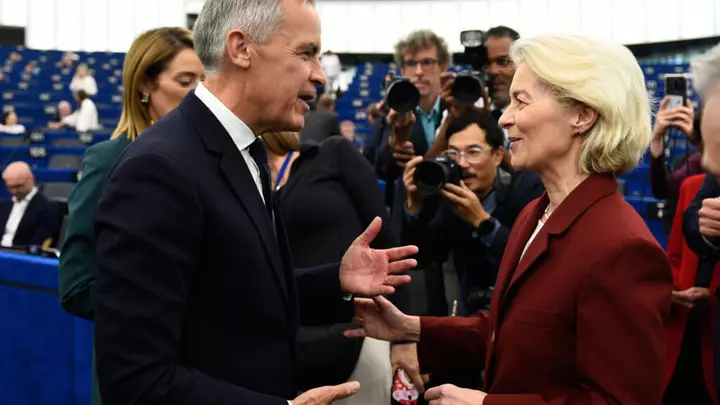
Canada and the European Union agreed to "ever closer association" but dropped the contentious idea of associate EU membership in a joint declaration seen by ahead of a Montreal summit hosted by Canadian Prime Minister Mark Carney starting on Thursday. The declaration, which officials plan to make public on Friday, said work to define the Canada-EU relationship would continue until another summit next year. European Commission President Ursula von der Leyen's suggestion of associate membership six weeks ago had been a divisive issue in negotiations among EU countries on the summit declaration, with Germany leading a group that argued they could not omats said.
Deeper ties to Europe are an important part of Carney's strategy to reduce Canada’s economic and security reliance on the US since President Donald Trump imposed tariffs on Canadian goods. Still, Canada's efforts to draw closer to the EU risk angering Trump as trade talks between Canada and the US continue. There is no precedent or legal definition for an EU “associate member”.
To display this content from YouTube, you must enable advertisement tracking and audience measurement. One of your browser extensions seems to be blocking the video player from loading. To watch this content, you may need to disable it on this site.
Trump previously called the EU’s proposal to make Canada an associate member “laughable” and said if he interpreted the move as a “hostile act,” the US might stop trading with Europe “on many things”. Carney told reporters on Tuesday that the summit this week is the launch of further formal negotiations that will take another year. The statement includes a joint initiative to improve international connectivity between Europe, Canada and Asia through "new subsea cable infrastructure".
It also proposes conducting a joint feasibility study on Canadian liquefied natural gas exports to Europe and enabling young Canadians and Europeans to work across the Atlantic. Julian Karaguesian, a former adviser at Canada’s Finance Ministry, described the summit as “a bit of a show”. Canada ships nearly 70% of its exports to the US while the EU accounts for about 9% of Canada’s total trade.
The statement says European and Canadian leaders pledge to reaffirm their commitment to a rules-based international order and that they “deeply regret” the sanctions the US imposed on the Netherlands-based International Criminal Court. Read moreFrance, Germany seek new EU rapid response tool against trade threats Appleton said Canada and the EU agreeing to work closely on economic security measures might anger the US. He added that the statement commits Canada to making its AI and digital rules work alongside Europe’s, when Washington considers EU-style digital regulation a trade barrier.
Extract — continue reading at the source.