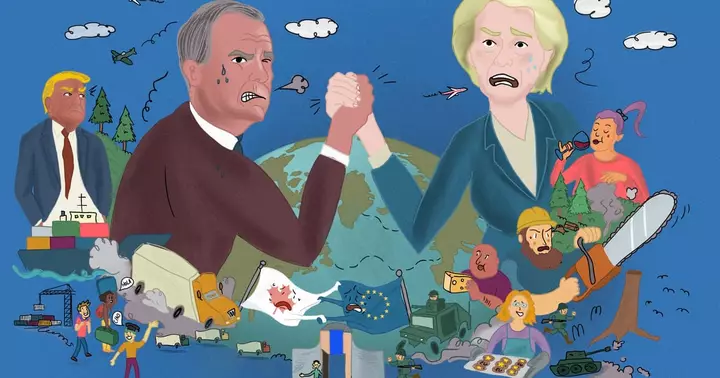
Mark Carney’s pursuit of a global alliance of middle powers has a Europe problem. Canada’s prime minister wants to help build a new world order that can counterbalance the power of the United States and China. But his vision depends on a new relationship with a Europe that doesn’t see itself as a middle power at all.
European Commission President Ursula von der Leyen has a different vision: a Brussels-centered bloc that extends the EU’s economic and geopolitical influence, starting with Canada. The idea, according to senior European lawmaker Siegfried Mureșan, is to create an opportunity for the EU to become the “global center of gravity for liberal democracies.” The competing visions will be tested this week when Carney and von der Leyen meet in Montreal for a summit intended to chart a new course for transatlantic relations. Both want to demonstrate they can prosper in a world upended by U.S.
But they have different ideas about their curious new alliance — and face political resistance that could limit how far the partnership can go. Von der Leyen’s offer of “associate membership” in the EU surprised officials on both sides of the Atlantic. Four diplomats told POLITICO they were not consulted before she floated the idea in the State of the Union.
The officials added that they don’t understand the label, which has yet to be defined. Germany has since led pushback on the plan. The leaders are under pressure to leave Montreal with more than a liberal democratic photo-op.
For starters, they need to decide what “associate membership” means — and disarm resistance in the EU capitals blindsided by von der Leyen’s plan. Canada’s Ambassador to the EU Jonathan Wilkinson told POLITICO last month that people got too hung up on a label that was revealed prematurely. Carney called the Canada-EU relationship an “alliance for the future” when he addressed European lawmakers in Strasbourg.
Wilkinson said the Canada-EU project will show other democratic nations how to deepen partnerships. Ottawa considers the EU an obvious partner in its push to diversify trade away from the U.S. There’s already a free-trade agreement that both sides view as being underutilized.
Extract — continue reading at the source.