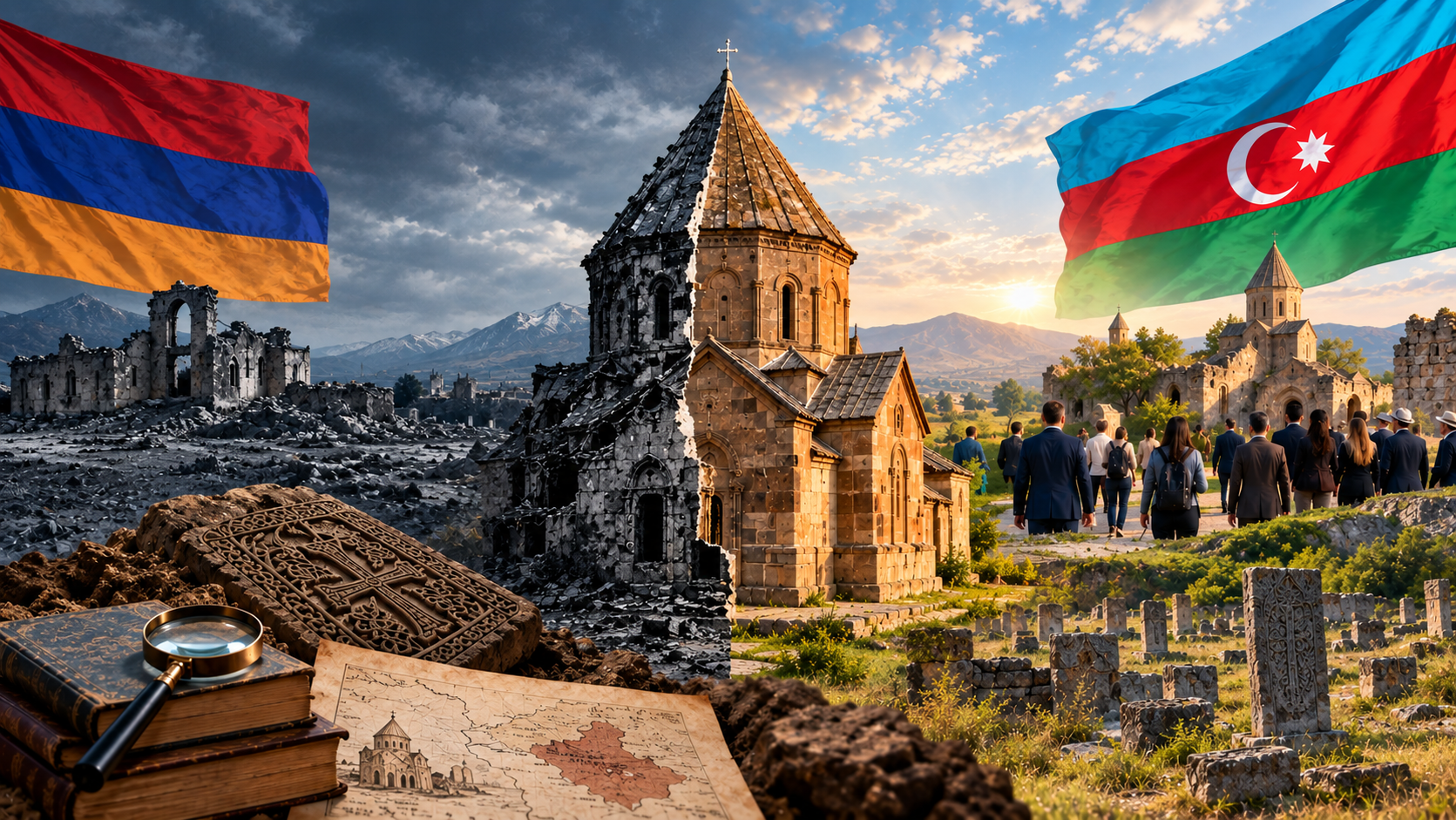
The question of Caucasian Albania is far from an issue that usually leads to war. However, the issue has escalated to such an extent that it appears to offer a pretext for certain individuals, fueled by a spirit of revanchism, to once again bring the agenda of war to the forefront. This issue is an archaeological and epigraphic problem of how to allocate the churches in the Southern Caucasus belonging to the long-extinct Christian kingdom, and what that might imply in terms of who can lay claim to them now.
But in the case of Edmon Marukyan, Armenia's ex-Ambassador-at-Large, what appears to be an archaeological debate on church architecture has transformed into something much more dangerous, and precisely because of what it represents, the use of exactly those revanchist arguments for which people never stopped dreaming of another war, to bring up the very notion of war anew. In his latest lengthy entry, Mr Marukyan accused Euronews of journalistic malpractice for interviewing a senior Azerbaijani official without confronting him over allegations of cultural destruction in Nakhchivan dating back decades. He went further, warning that a diplomatic tour of Gandzasar and Dadivank monasteries - attended by 150 representatives from 58 countries - was simply the opening act of a plan to erase what remains of Armenian heritage in the region.
"Silence," he wrote, "isn't neutrality." Let us start with the scale of what Mr Marukyan leaves out. Azerbaijan government lists more than 400 historical and religious monuments, 67 mosques and roughly 192 shrines and mausoleums among them, in territories occupied by Armenian forces between 1992 and 2020. The Azerbaijan National Academy of Sciences found that of 67 mosques once functioning in Karabakh and surrounding districts, 63 were completely destroyed and four partially so.
Aghdam, a town of some 36,000 people before its capture in 1993, was levelled so thoroughly that international journalists began calling it "the Hiroshima of the Caucasus"; its 19th-century Juma mosque survived largely because occupying forces used it to house livestock rather than because anyone thought to preserve it. Official Azerbaijani tallies, compiled with UNESCO cooperation, count 927 destroyed libraries holding 4.6m books, 22 looted museums, and 85 music and art schools razed across the formerly occupied districts. The US State Department documented desecrated Azerbaijani cemeteries in Aghdam where "only one broken headstone remained." Nakhchivan's history is contested enough to deserve its own reckoning, not this one.
What the episode does make clear is that cultural loss in this conflict runs in more than a single direction, and that one side's monuments merit international scrutiny while the other's four hundred, destroyed in plain, documented view, are an inconvenient footnote unworthy of a tweet. However, the deeper problem with Mr Marukyan's intervention is less historical than political. It comes at a time when Azerbaijan and Armenia are slowly inching towards formulating a real peace plan, and at a time when international diplomats, rather than the press offices of either regime, are now getting direct access to territories which have been closed military zones for three decades.
A people who are sure of their version of history do not go about screaming accusations of complicity in genocide against outsiders who show up to see for themselves with a camera. They invite the outsiders into the site of devastation or reconstruction and let the ruins or restorations speak for themselves. This is exactly what took place in the September tour which Mr Marukyan criticized: fifty-eight countries toured Gandzasar and Dadivank in broad daylight under journalistic supervision, which is quite an unusual way of conducting a covert genocidal mission.
Extract — continue reading at the source.