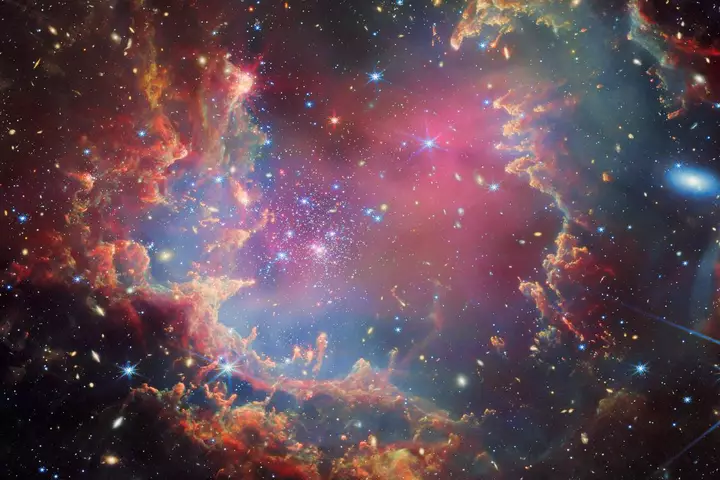
Journey to a satellite galaxy roughly 200,000 light-years from Earth, featuring the young star cluster NGC 602. With data from Webb’s NIRCam (Near-InfraRed Camera) and MIRI (Mid-InfraRed Instrument). Courtesy HUBBLE/WEBB/ESA In the story of cosmic history, one of the most important supporting characters is dust.
As clouds of interstellar gas cooled and condensed in the early Universe, dust grains absorbed and re-emitted radiation, eventually forming stars. Later, dust provided the raw material from which planets could form and grow. Dust grains may even have been the surfaces on which the first complex organic molecules formed.
Yet, if you ask most cosmologists, they’ll tell you that dust is a sheer nuisance. In astrophysics, ‘nuisance’ is a quasi-technical term. Astrophysicists call any phenomenon that gets in the way of the thing they actually want to study a ‘nuisance’.
Dust grains emit polarised light that can mimic subtle signals from the afterglow of the Big Bang (the cosmic microwave background) that cosmologists have spent decades and billions of dollars trying to detect. A cosmologist studies dust not to uncover its role in shaping the cosmos, but to subtract it – the term ‘sweeping under the rug’ couldn’t be more apt. This dichotomy between ‘signal’ and ‘nuisance’ is found across many sub-fields in astronomy.
Astronomers who study a phenomenon called ‘weak lensing’ use the subtle distortions of light caused by gravity to map invisible dark matter. For them, the ordinary matter that makes up everything we can see is a nuisance. Pulsar timing astronomers use rapidly spinning neutron stars called pulsars as extraordinarily precise clocks to detect the passage of gravitational waves through the galaxy.
For them, the nuisance is ionised interstellar gas, which scatters and disperses the light from pulsars. Yet one astronomer’s nuisance is another’s treasure. Just as a laser beam reveals the intricate swirls of smoke in a dark room, pulsars illuminate the fine structure of the interstellar medium, the unlit space between galaxies.
Extract — continue reading at the source.