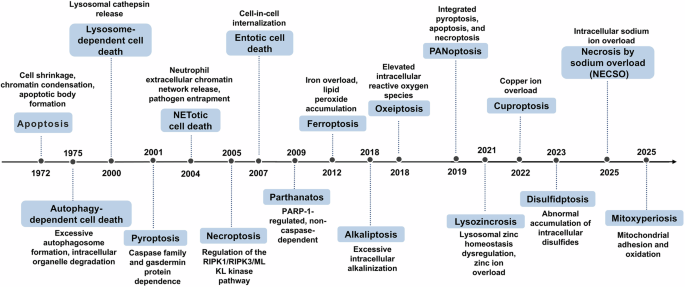
The precise regulation of cell death is indispensable for embryonic development, tissue homeostasis, and the pathophysiology of human disease. Dysfunctions in regulated cell death (RCD) pathways constitute a critical aetiological factor in diverse pathologies, including oncogenesis, neurodegenerative disorders, autoimmune conditions, and ischaemic injury. Substantial efforts to therapeutically target these mechanisms are therefore needed.
In this review, we present a systematic analysis of the molecular machinery underlying distinct RCD processes, including apoptosis, necroptosis, pyroptosis, and multiple forms of metal-dependent cell death. We delineate how the interconnected signalling networks that govern these pathways are coordinated at the cellular and organismal levels and how their dysregulation drives disease progression. We also emphasise translating mechanistic insights into clinical practice by critically evaluating pharmacological strategies.
Furthermore, this review systematically describes how an improved understanding of pathway crosstalk mechanisms, the discovery of predictive biomarkers, and advances in targeted delivery systems collectively drive the development of precision therapeutic strategies. Finally, we discuss current challenges in achieving on-target specificity and minimising off-tumour toxicity, and we outline future directions for integrating these approaches into immunomodulatory and combination frameworks. By bridging fundamental cell biology with translational medicine, this review aims to illuminate both the conceptual foundations and the clinical potential of targeting cell death in human diseases.
The study of cell death has evolved conceptually over time. Initially, it began with morphological descriptions of necrosis and apoptosis.1,2 Later, molecular analyses of regulated pathways such as necroptosis and pyroptosis were added.3,4 Recently, the focus has shifted towards mechanisms driven by metabolic reprogramming and metal homeostasis regulatory networks, including ferroptosis and cuproptosis, as well as other forms of cell death.5 Each conceptual breakthrough, frequently proven by a pivotal chemical probe (e.g., Nec-1 or Erastin) or transformative technological innovation, has progressively refined the ontological framework of regulated cell death.5,6 This expanding landscape continues to provide novel therapeutic targets and fundamentally reshape our understanding of cellular fate. From the perspectives of pharmacology and medicinal chemistry, the expanding molecular map of RCD is a therapeutic gold mine.
These pathways often rely on druggable nodal proteins such as kinases, proteases, or metabolic enzymes. The clinical success of venetoclax, a B-cell lymphoma 2 (BCL-2) inhibitor, alongside the intensive development of RIPK1 or NLRP3 inhibitors, underscores the transformative potential of modulating cell death in disease treatment.3,7,8 However, extensive work is needed to transform this potential into safe and effective therapies. The apoptotic pathway is currently the most mature field for clinical translation, with drugs already approved for market and several new-generation drugs entering the clinical stage (see “Targeting apoptosis” section).
These include IAP antagonists, BCL-2 inhibitors, and BH3 mimetics. RIPK1 and RIPK3 are key regulatory kinases in the necroptosis pathway, and their inhibitors have therapeutic potential in inflammatory diseases. To date, several RIPK1 kinase inhibitors have entered clinical trials (see “Clinical Trial Progress Targeting Necroptosis” section), with indications such as autoimmune diseases (psoriasis, ulcerative colitis, rheumatoid arthritis and inflammatory bowel disease (IBD)), infection-related inflammatory responses (severe COVID-19), haematological diseases (haemophagocytic lymphohistiocytosis (HLH), acute graft-versus-host disease (aGVHD)), and neurodegenerative diseases (Alzheimer’s disease (AD), amyotrophic lateral sclerosis (ALS)).
Extract — continue reading at the source.