This article has been reviewed according to Science X's editorial process and policies. Editors have highlighted the following attributes while ensuring the content's credibility: Cells must produce energy despite changing conditions. But what keeps metabolic enzymes functional during temperature fluctuations?
A team led by professor Simon Ebbinghaus and Dr. Harshita Rastogi at Ruhr University Bochum and the Research Center for Chemical Sciences and Sustainability investigated this question using the platelet isoform of phosphofructokinase-1 (PFKP), a central enzyme in glucose metabolism. They found that thermal protection depends less on the size of crowding molecules than on the subtle chemical interactions among them, which can determine how well the enzyme remains active as temperatures rise.
Their work was published in the journal Angewandte Chemie International Edition. Enzymes are molecular machines that drive the biochemical reactions of life. PFKP controls a key step in glycolysis, the pathway through which cells convert glucose into energy and molecular building blocks.
Enzymes do not function in isolation: Inside cells, they are surrounded by proteins, sugars and many other molecules. "This molecular environment changes when cells experience stress, reorganize their metabolism, or form temporary enzyme assemblies," explains Ebbinghaus. "A key question has therefore remained open: Is it mainly the limited space around an enzyme that matters, or is the chemical nature of its neighbors equally important?" To investigate this, the researchers studied PFKP in controlled solutions containing crowding molecules of different sizes and chemical properties.
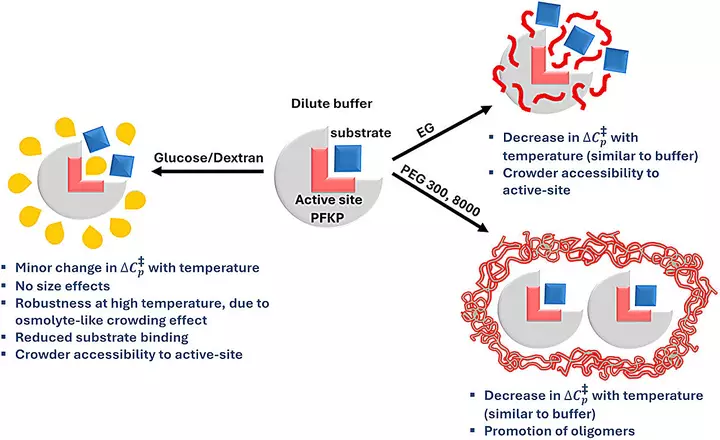
They measured how enzyme activity changed with temperature, assessed its structural stability and used molecular simulations to examine interactions that cannot be observed directly in experiments. All crowded environments reduced PFKP activity at lower temperatures. "At higher temperatures, however, the results revealed a striking difference," says Rastogi.
"Sugar-based molecules, including glucose and dextran (a glucose polymer), helped PFKP retain activity over a broader temperature range." Because glucose and the much larger dextran had similar effects, molecular size alone could not explain the result. Instead, the findings point to the importance of "soft" chemical interactions: weak, reversible contacts among the surrounding molecules, the enzyme and its substrates. The simulations showed that these molecules can influence regions near the enzyme's active site, affecting both enzyme flexibility and substrate positioning.
Extract — continue reading at the source.


