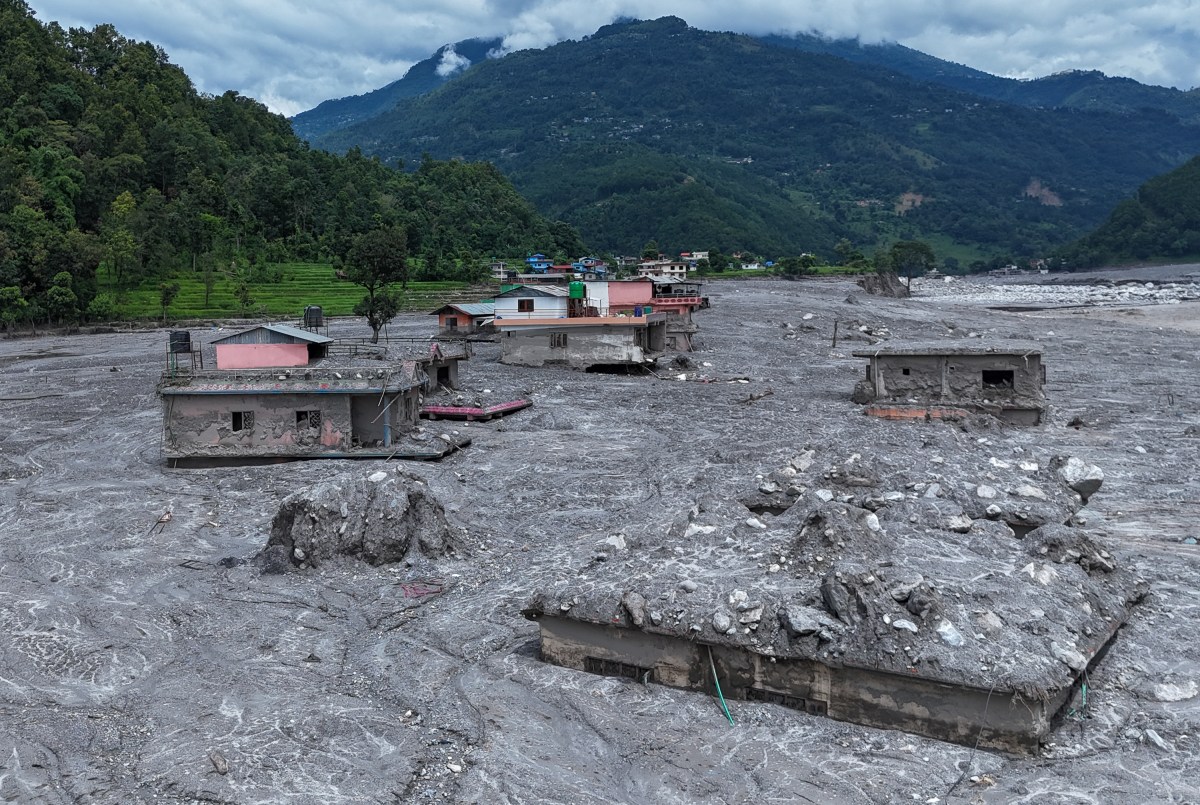
China finds itself fighting an information war over its strategic interests in the Himalayas after last month’s devastating flash floods on the Nepal-Tibet border put a spotlight on a major hydropower megaproject near India—over 600 miles away and still shrouded in secrecy. Flooding triggered by a glacial collapse on August 26 claimed over 1,300 lives and up to four times that are still missing, including dozens of Americans. Geological Survey said the Lhenda and Trishuli rivers carried glacial debris—ice, water, boulders and later rubble—approximately 62 miles downslope into central Nepal.
China has no hydropower stations upstream, and its infrastructure projects could have played no part in the ice avalanche, the latest assessments suggest. But China is the main contributor of civil engineering works along the riverbanks, so experts speculate that its bridges, highways and buildings in the valley may have altered the speed and composition of the debris flow. While China and its neighbor India vie for influence over Nepal, Beijing’s skeptics in New Delhi say the worst disaster of its kind in the Himalayas should serve as a warning about Chinese hydropower plans elsewhere in Tibet and their effects downstream.
Preliminary reports aided by satellite imagery said the landslide likely began at an elevation of over 17,000 feet, on the northern slope of the Langtang Lirung mountain in Nepal. The collapsing glacier crashed into the valley floor at such a force that it registered as a magnitude 5.2 earthquake, according to the U.S. The first images of the torrent of mud and floodwater came from surveillance cameras at China’s Gyirong port, which was washed away in a matter of seconds.
The border crossing was the main land route for China’s trade with Nepal. For those living and working in the path of the floods, what little forewarning there was had come too late. Satellite imagery provided by Planet showed the destruction left behind by the fast-moving floodwater, like a giant scar in the earth.
When disaster strikes, Beijing’s first reaction is containment, of the damage but also of information. Within hours of the flooding, videos filmed by witnesses were censored on Chinese social media apps almost as quickly as they were being uploaded. Only approved state media footage remained, as well as any videos that made it out of China’s Great Firewall.
It took the Chinese government 11 days to permit foreign media to report from the Gyirong border area. Beijing’s intense need for control created an informative vacuum in which unfavorable narratives bloomed. One widely quoted statement came from Madhav Prasad Chaulagain, the former Nepalese environment minister, who said China had failed to warn Nepal about the floods.
Extract — continue reading at the source.