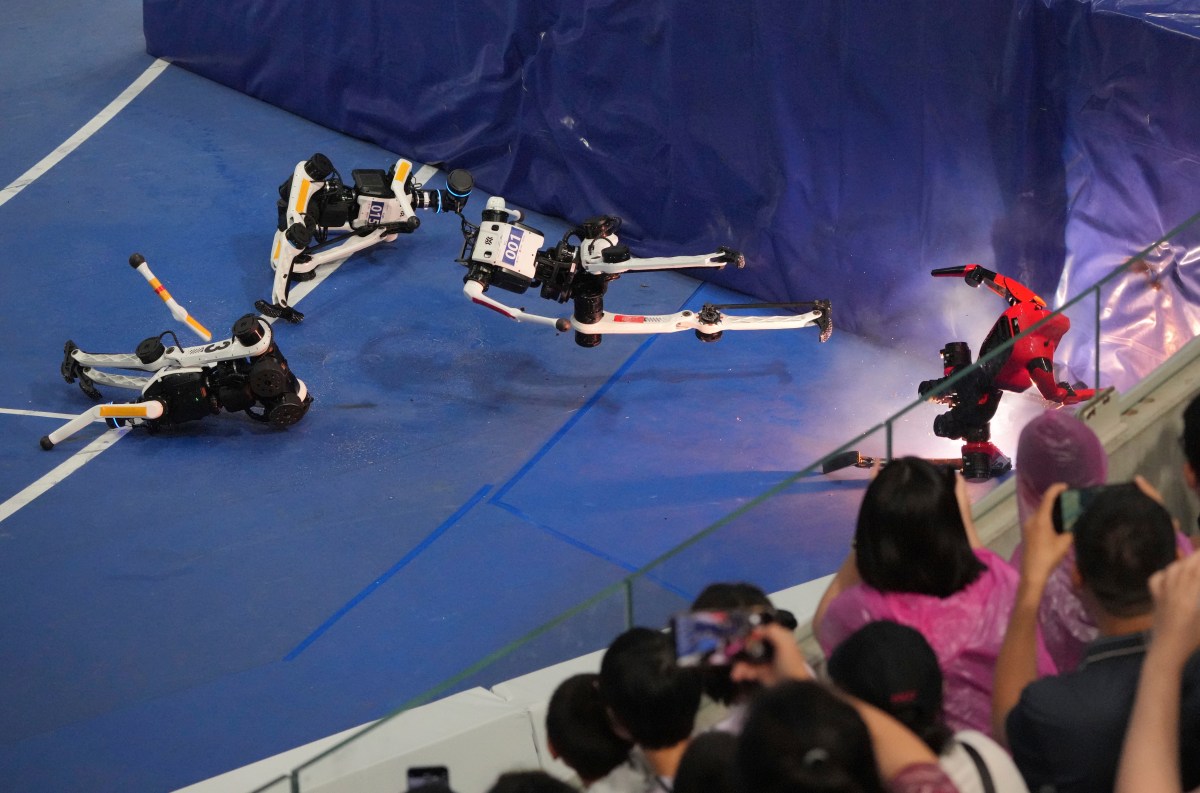
For any sporting contestant, there is a fear that when it’s time to compete, you could crash and burn. For the robots at the World Humanoid Robot Games in Beijing, though, that fear is a reality. The competition, now in its second year, involves over 2,000 automated competitors taking part in Olympic-style disciplines like running, boxing and high jump.
A key difference from the Olympics, though, is that sometimes the robots can’t stop. The robots—including one which ran faster than Usain Bolt’s 100 m world record time—hit a literal wall at the end of sprint races, slamming into a large blue crash pad. Robots splintered, collapsed, and even burst into flames over the course of the games.
Nearly all competitors had to be removed by stretcher. Clips from the games have quickly amassed millions of views online, as social media users share their fascination with the spectacle’s descent into fiery chaos. One video, posted by the news account on X Breaking911, shows a robot running very fast, then failing to stop.
It slams into a cushion and breaks at the waist. The clip has been viewed 37.9 million times as of reporting. Another clip shows a robot trying – and failing—to make it through an obstacle course, its attempt ending in a face plant.
The event is intended to showcase advances in embodied AI and robotics. Specifically, autonomy, mobility, dexterity and coordination. The games ran from August 22-26 and featured 2,056 robots.
Professor Subramanian Ramamoorthy FRSE, the chair of Robot Learning and Autonomy at the University of Edinburgh in Scotland told Newsweek over email: "From a technical standpoint, such competitions are interesting mainly because they serve as neutral testbeds within which to compare capabilities, and use that benchmarking to guide the details of development directions for future research." "In areas like robotics, many issues are not apparent unless one views capabilities in the context of full system behavior," Ramamoorthy added. The competition was divided into two main categories. One was competitive events modeled on human sports: There were also scenario-based events for the robots designed to test practical skills, namely: The sophomore year of the competition scaled up.
Extract — continue reading at the source.