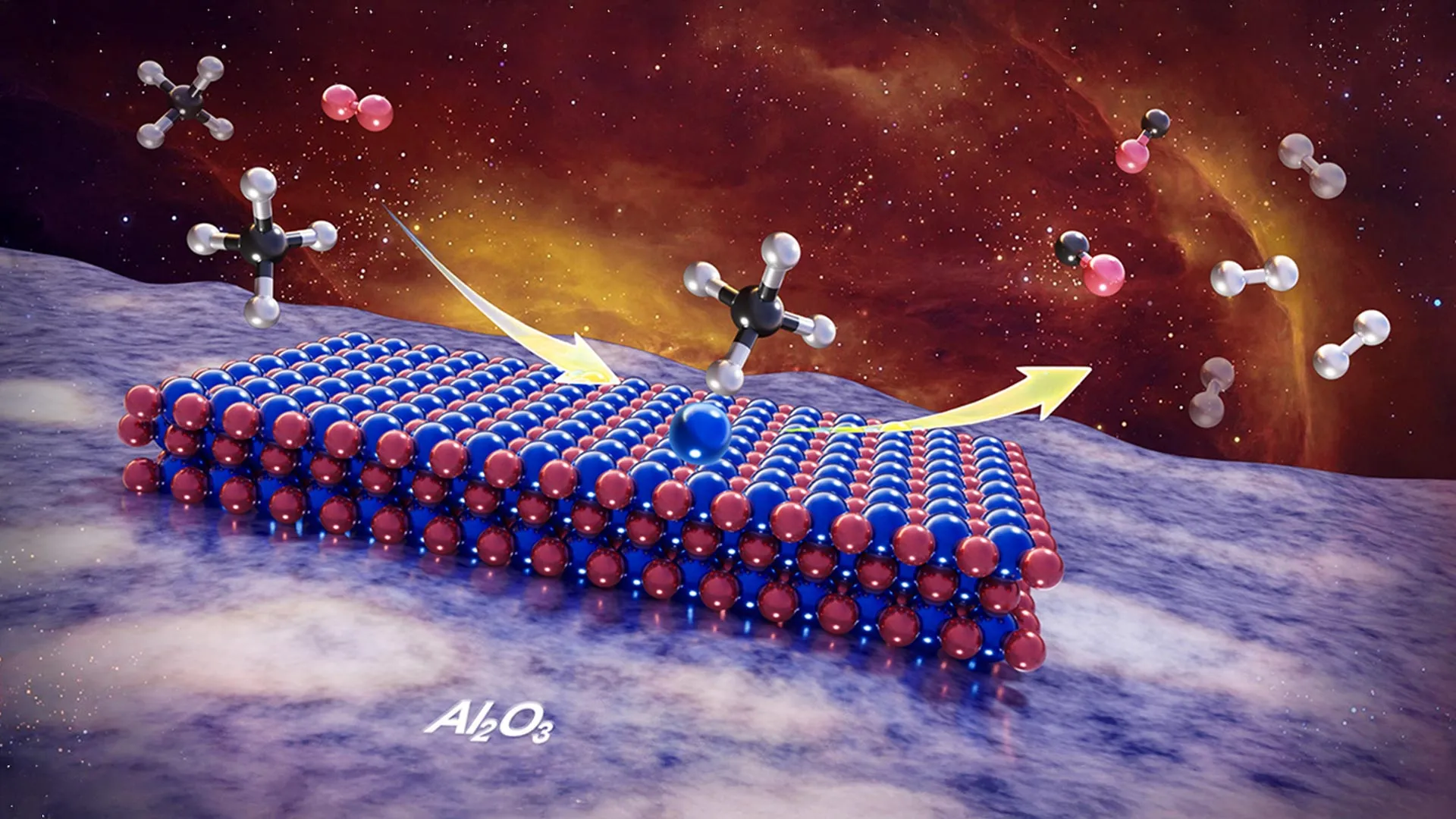
Partial oxidation of methane (POM) is considered a promising industrial method for producing syngas, a mixture commonly used to make fuels and chemicals. For years, scientists have assumed that metallic nickel (Ni) nanoparticles serve as the main active centers that drive this reaction. However, there has been an important unresolved question.
The metallic Ni observed after a reaction may simply form when nickel oxide is reduced by syngas at high temperatures, rather than representing the species that actually performs the catalysis. Nickel can change both its oxidation state and its atomic arrangement under the high-temperature redox conditions involved in POM. Until now, these changes have been difficult to track in detail, making it challenging to determine the true structure responsible for the reaction.
A Hidden Active Structure Forms During the Reaction In a recent study published in Nature Catalysis, researchers found that highly active structures can form in situ when the surface of NiO reconstructs during POM. The results reveal the atomic-scale source of the catalytic activity and show why it is important to observe catalysts while they are operating under realistic reaction conditions. The research was led by Profs.
Tao Zhang, Aiqin Wang and Xiaoyan Liu from the Dalian Institute of Chemical Physics (DICP) of the Chinese Academy of Sciences (CAS), together with Prof. Tao Yang from Xi'an Jiaotong University, and Prof. Hutchings from Cardiff University.
To investigate the process, the team created a Ni/Al2O3 catalyst containing only 0.8 wt% Ni using a microemulsion method. Despite its relatively low nickel content, the catalyst performed strongly during POM. It converted 92% of the methane, while CO and H2 selectivities reached 87.0%, with the H2/CO molar ratio remaining stable at about 2.0.
One of the most striking findings was that almost no metallic Ni could be detected in the catalyst after the reaction. Even so, its overall performance was comparable to that of an 8.0 wt% Ni/Al2O3 catalyst produced through impregnation, despite containing only one tenth as much nickel. The low-loading catalyst also performed far better than another 0.8 wt% Ni/Al2O3 material prepared using the same impregnation method.
Extract — continue reading at the source.