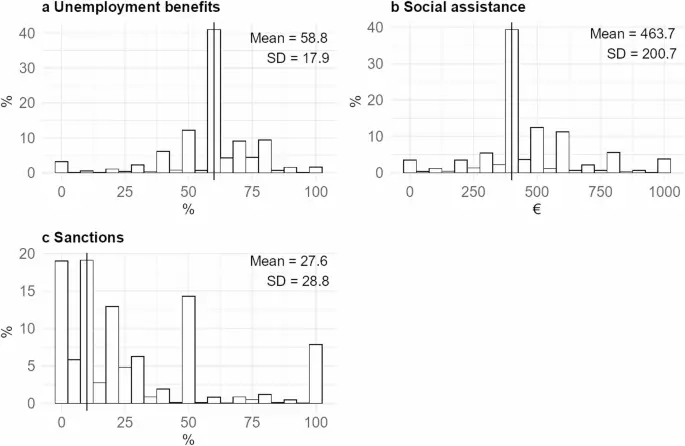
We examine whether welfarechauvinistic attitudes, the preference for restricting immigrants’ access to welfare benefits, differ by benefit type and whether citizenship attenuates migrant penalties in welfare deservingness. Using a between-subjects multifactorial survey experiment embedded in a probability-based online panel (March 2019; N = 4,890), we asked respondents to evaluate an unemployed benefit claimant on three outcomes: support for earnings-related unemployment benefits, needs-based social assistance, and benefit sanctions. Across outcomes, migrant profiles are judged less deserving than otherwise identical ethnic German profiles.
Penalties are of similar magnitude for unemployment insurance and social assistance while sanction differentials are smaller and limited to some, more culturally distant groups. Citizenship, as an institutional signal of integration, attenuates penalties within shared ethnic origin but does not fully close the gap to ethnic Germans, even under favorable deservingness cues. To what extent does the public discriminate against migrants by restricting their access to welfare benefits, and under what conditions might this gap diminish or even disappear?
These questions are increasingly relevant in Western societies, where immigration and welfare state sustainability remain central to political and policy debates. Welfare chauvinistic policies that restrict immigrants’ access to general social security schemes are found in many Western countries1,2. Populist right-wing parties strongly advocate such policies, yet also left-wing parties are found to be reluctant to open general social protection schemes to immigrants2.
A large body of research finds that citizens on average tend to hold welfare chauvinistic attitudes (WCA), the belief that immigrants should have restricted access to social benefits3,4,5,6,7. Attitudes can have significant consequences for both social cohesion and the legitimacy of welfare systems in diverse societies8,9,10. Scholars have identified two key factors shaping WCA: cultural distance to immigrant groups and perceptions of reciprocity, particularly the extent to which migrants are seen as making integration efforts or contributing economically5,11,12.
In this paper, we address two important limitations that constrain our understanding of the mechanisms behind WCA. First, most studies aggregate across different types of welfare benefits or examine a single benefit in isolation, thereby masking important distinctions in how various welfare instruments trigger chauvinistic responses. While some research focuses on general deservingness to receive government support6,13, others examine specific domains such as unemployment benefits12,14,15, housing and disability benefits7,16, or pensions17.
Recent findings by Eick and Larsen18 suggest that WCA tend to be stronger for unemployment benefits than for social assistance. Despite these insights, little empirical work has explicitly theorized or experimentally tested how attitudes vary across different types of cash benefits, nor has it explored how underlying expectations of reciprocity and need-based legitimacy might shape these variations. Addressing this gap is both theoretically and societally important.
Extract — continue reading at the source.