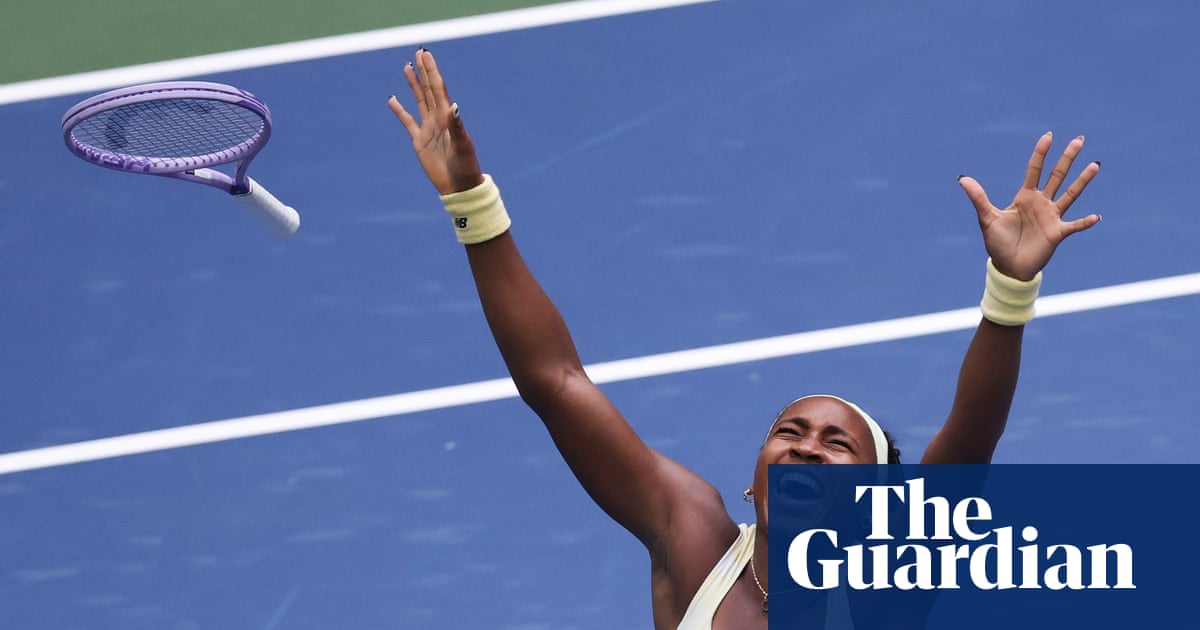
Coco Gauff has played far cleaner matches than on Wednesday afternoon. But few players today on the women’s tour have become better at finding answers on the fly when almost nothing is working for them. The 22-year-old American’s serene march through the US Open women’s draw hit extreme turbulence early in her quarter-final clash with fifth-seeded Mirra Andreeva inside Arthur Ashe Stadium.
She dropped the first four games before surrendering the opening set in 26 minutes, ending a streak of 20 consecutive sets won dating back nearly a month. She piled up 12 double faults and 42 unforced errors, the majority off a forehand in open revolt. She found herself one point from defeat not once but twice during a hairy second-set tiebreaker.
But the fourth-seeded Gauff somehow wriggled free, prevailing 2-6, 7-6 (7), 6-2 over the reigning French Open champion to extend a 10-match winning streak and reach the last four in New York for the first time since her grand slam breakthrough three years ago. I was able to reset and somehow get out of that one.” If she needed a template for the comeback, she had only to look back 24 hours. Gauff said she drew inspiration from Frances Tiafoe, who had recovered from two sets down and two points from going out against Alex Michelsen on the same court Tuesday to reach the men’s semi-finals.
As she staved off elimination in a white-knuckle tiebreaker, her only concern was not losing it. Honestly, once the third set started, I felt pretty confident that I was going to come out with that one. The result further burnished Gauff’s precocious record of deep runs at the grand slams.
She has now reached seven major semi-finals before turning 23, a total surpassed only by Venus Williams (13) and Serena Williams (10) among active players at that age. It was hardly a showcase for the reconstructed serve that has underpinned a late-summer resurgence that included her first title of the year in Cincinnati. But even a ragged serving performance like Wednesday’s offered evidence of how far her perspective has evolved.
A year after leaving the US Open with her serve and confidence in disarray, she believes she has acquired a broader understanding of the inevitable peaks and troughs of a career – and a deeper conviction that she can survive them. If anything, it inspires me a little bit more to keep working, as I see how much I have improved in a year. Even though my serve didn’t show up well, it’s OK.
Extract — continue reading at the source.