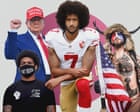
America likes nice round numbers, perfect for anniversaries and reflections, and it has, suddenly, been 10 years since Colin Kaepernick first protested police killings – more accurately, police killings of Black people that went unpunished either internally or by the courts – by taking a knee during the national anthem for the entirety of the 2016 NFL regular season. He never played in the league again. Ten years covers a lot of ground, especially in these years of American darkness, and many of the important details surrounding Kaepernick, his banishment and significance have disappeared, time replaced by more time and more darkness – time moving faster than ever, at internet speed, where nothing matters, where nothing sticks.
We consume by clip, by click, by meme, and knowledge by meme is not knowledge at all. Much of the Kaepernick story was reduced to his personal banishment, but second to Barack Obama, Kaepernick is the face that propelled white anger into a “culture war” that continues earnestly into its second decade. It has traveled through the NFL, through Hollywood, the White House, and now is now corroding the WNBA.
Obama’s ascent to the White House confirmed the unlikely prospect that a Black person could be elected president, ostensibly the ultimate symbol of American possibility. It was not a universal sentiment. In the annals of American protest, which has included suffragettes breaking windows, students blocking traffic, Black Panthers armed in public, economic boycotts and marches on Washington, Kaepernick was mild by comparison – he gave voice with 60 seconds of silence.
Ten years later, one view of the Kaepernick legacy can be seen through a harsh, retrofitted lens: sports leagues would largely purge the troublemakers and co-opt the protests, reducing them into useless, corporate-friendly gestures; an American electorate that voted Donald Trump into power twice, as his unapologetic, unambiguous racism reflected theirs; media outlets responding in agreement, coalescing around Trump’s whiteness, appeasing their rightsholders, readers and viewers by making the conscious choice – a clear and egregious dereliction of journalistic duty – to silence the voices within who make them uncomfortable; a player class that was never nearly as bold as its greatest legends well aware of Kaepernick’s fate, unwilling to repeat it, and operating as puppets. They didn’t have far to go. While Trump called NFL players “sons of bitches” in his first term and demanded Kaepernick be banned from the league, NFL players undermined him.
Dallas Cowboys quarterback Dak Prescott assured his bosses in 2018 that he was no radical, not merely by playing football but demeaning Kaepernick’s protest. It’s not about taking a knee,” Prescott said, undermining centuries of evidence to the contrary about the efficacy of physical protest. Even the most devout Cowboys fan could probably not name a single example where Prescott took action.
He simply didn’t want to get involved. Michael Vick, ex-convict, killer of dogs, but redeemed by the NFL following his prison sentence, told Kaepernick to “cut his hair” if he sought a pathway to forgiveness. Hall of Famer Ray Lewis told Kaepernick to “keep his mouth shut”.
Extract — continue reading at the source.