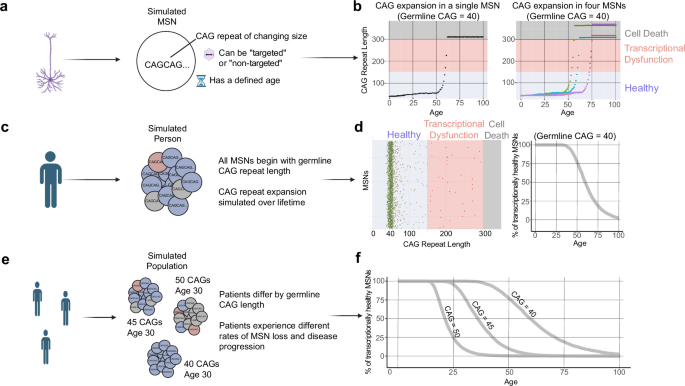
Genetic modifiers of Huntington’s disease (HD) disease onset and progression implicate somatic instability (SI) of the expanded CAG repeat as a key pathogenic driver, with MSH3 emerging as a therapeutic target. Here, we generated a computational model that uses HD patient data to infer therapeutic effects of reducing SI and in parallel designed an artificial miRNA to lower MSH3 mRNA (miMSH3) after delivery with AAV-DB-3, a previously described medium spiny neuron (MSN)-targeting AAV capsid variant. AAV-DB-3.miMSH3 achieved 48–94% MSH3 mRNA reduction in MSNs of nonhuman primates (NHPs), which when applied to predictive modeling predicts 50–120 % slowing of HD progression as measured by change from baseline in the composite Unified Huntington Disease Rating Scale.
Additionally, AAV-DB-3.miMSH3 reduced SI reduction by up to 46% in HdhQ111 mice. Cumulatively, the preclinical experimental data and the computational model support the translational potential of AAV-DB-3.miMSH3 as a disease-modifying therapy for HD. Huntington’s disease (HD) is a fatal, autosomal dominant neurodegenerative disease caused by an expanded CAG trinucleotide repeat ( > 35 CAG) in exon 1 of the huntingtin (HTT) gene.
The expanded CAG repeat is unstable and undergoes further expansion over a patient’s lifetime through somatic instability (SI) – particularly in vulnerable neuronal populations. In postmortem HD brains, Kennedy and colleagues identified large expansions of up to 1000 CAG repeats in striatal neurons1. Single-cell transcriptomic analyses of HD brain tissue revealed that medium spiny neurons (MSNs) with CAG repeat lengths of ≤ 150 maintain normal transcriptional profiles2.
In contrast, MSNs with CAG repeat lengths of > 150 display transcriptional dysregulation, a hallmark of HD pathogenesis3. Further, SI is evident in deep-layer cortical neurons and in mononuclear cells in blood from HD patients4,5,6. Together, these findings implicate SI as a major driver of neuronal dysfunction and disease progression, supporting it as a target for a disease-modifying therapeutic strategy for HD.
Genome-wide association studies (GWAS) offer critical insights into the role of SI in HD7,8,9,10,11. These studies identified mutS homolog 3 (MSH3) variants associated with clinically relevant outcomes, including age at motor onset and rate of disease progression. MSH3, a key component of the mismatch repair (MMR) machinery, binds MSH2 to form the MutSβ complex, which maintains DNA integrity by correcting large insertion/deletion loops that occur during DNA replication12.
HD patients with variants associated with reduced MSH3 expression show slower disease progression. For example, an MSH3 polymorphism that results in ~ 10% lower MSH3 expression reduced SI, slowed disease progression, and delayed disease onset by 1 year8. Likewise, heterozygous loss-of-function mutations in MSH3 (i.e., 50% MSH3 expression at birth) delayed average age at motor onset by 10.6 years13,14.
Extract — continue reading at the source.


