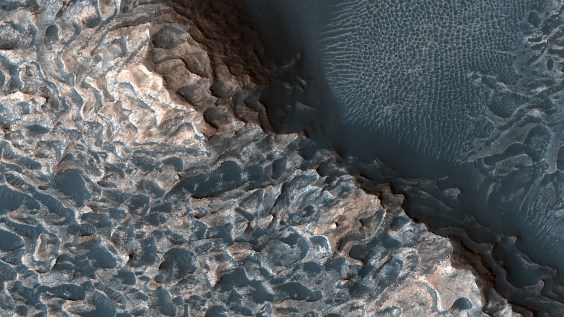
Sometimes, even the strangest alien landscapes can still have hints of Earth-like features in them. Case in point: the coral reef shapes captured by the Mars Reconnaissance Orbiter circling the Red Planet. There’s nothing living there now, but the regularity of the patterns etched into these layers of rock and dust suggests something cyclical formed them—perhaps regular dust storms with some groundwater mixed in, before water disappeared from the surface and left behind the arid Martian landscape we know today.
Read more: “The Best Mars Photos Taken by the Curiosity Rover” The photo shows the Arabia Terra region of Mars, packed with craters and canyons and significantly eroded after billions of years of weathering. It stretches as much as 2,800 miles across Mars, which is about the same as the continental U.S., coast to coast. What really makes this part of the Martian landscape pop are the colors, which are partly enhanced from the capture made by the HiRISE (High Resolution Imaging Science Experiment) camera.
With a mirror about a foot and a half across, the instrument is effectively a telescope pointed down at the planet, capturing color in three bands: near-infrared, red, and blue-green. The bands have been shifted to make each of them visible, with the contrast further enhanced as well. In real life, if you were orbiting above Mars at a steady altitude, everything would have more of a reddish-brown tint.
That said, the rock and sand is genuinely darker and more blue: It’s volcanic basalt, rich in iron and magnesium. The lighter patches are finer-grained, with materials including salt and clay. The wind and loose debris whipping across the surface produces the uneven, jagged edges of rock.
Scientists are currently analyzing these rock layers to see what they can tell us about the planet’s past. The stacks of sediment now solidified into rock show that the surface and atmosphere have shifted over time, in a regular pattern, and that water is likely to have been involved. For now, though, we can only make inferences from space.
If one day we’re able to get a rover into place in Arabia Terra, it will be able to tell us much more about what these rocks are made of and how they formed. Subscribe to our free newsletter.
Extract — continue reading at the source.